Gaudí and his Masterpieces Free Tour
- 2 h 30 min
- Walking tour
- Max. 25
- Small group
- Free cancellation
- Until it starts
- No upfront payment
- You give at the end
About this free tour
The Eixample is the neighbourhood where Barcelona decided to think big. In the late 19th century, when the city tore down its walls and spread out over a grid designed by Ildefons Cerdà, the Catalan bourgeoisie, grown rich on industry, went looking for architects who could turn their houses into genuine manifestos. That is where Catalan Modernisme came from, and its star avenue, the Passeig de Gràcia, filled up with façades that seem to defy the straight line. On this free walking tour you stroll along that showcase and learn how to read it: why an entire city dared to build in curves and who was the man who took that idea further than anyone, Antoni Gaudí.
It works well if you are travelling independently and want to understand what you are seeing instead of just photographing it. It is a good plan for families, because the stories of dragons, bones and quarries hook the kids too, and for anyone drawn to history and architecture. You do not need to know anything beforehand: your guide gives you the context, the period and the anecdotes so that every building makes sense.
Along the way you see from the outside the Casa Batlló, with its balconies that recall skulls and its roof of scales; the Casa Amatller right next door, home of the chocolatier Amatller and topped with a stepped, Flemish-looking gable, on the famous Manzana de la Discordia where the great architects competed wall to wall; La Pedrera (Casa Milà), all rippling, without a single straight line on its stone façade; and you finish by looking at the Sagrada Família from the outside, the work Gaudí never saw completed and that keeps growing more than a century later.
It is a free walking tour, so you book for free and pay nothing in advance. At the end, each person gives a voluntary contribution based on how much they enjoyed the walk; in Barcelona the usual amount is around 15 to 20 euros per person. That way you decide at the end, with the walk already done and no surprises.
This is one of the routes in the Trip Tours network in Barcelona and it pairs well with the others: you can spend this morning or afternoon on Gaudí and Modernisme, and another on the old town or the rest of the city to round off your visit.
Highlights
- The Sagrada Família seen from the outside, Gaudí's unfinished work that has been under construction for more than 140 years
- The Passeig de Gràcia from end to end, with the Casa Batlló and La Pedrera on the same avenue
- The Manzana de la Discordia, where several Modernista architects challenged each other wall to wall
- A small group of no more than 25 people, so you go at ease and can ask questions
- A local guide who explains who Gaudí was and why Barcelona dared to build in curves
- Book for free and give a voluntary contribution at the end: you decide based on how much you enjoyed it
What you'll see
Sagrada Família
The temple that Gaudí turned into his life's work. He began it in 1882 and it is still under construction: you see it from the outside and understand why its façades tell stories in stone, as if they were an open book.
Casa Batlló
At number 43 of the Passeig de Gràcia, Gaudí remodelled this house between 1904 and 1906. They call it the house of bones for its skull-shaped balconies and its columns like shinbones, crowned by a roof that mimics the back of a dragon.
Casa Amatller
Right beside the Casa Batlló, it was designed by Josep Puig i Cadafalch for the chocolatier Antoni Amatller. Its stepped gable has the air of a Flemish house and deliberately contrasts with Gaudí's.
La Pedrera (Casa Milà)
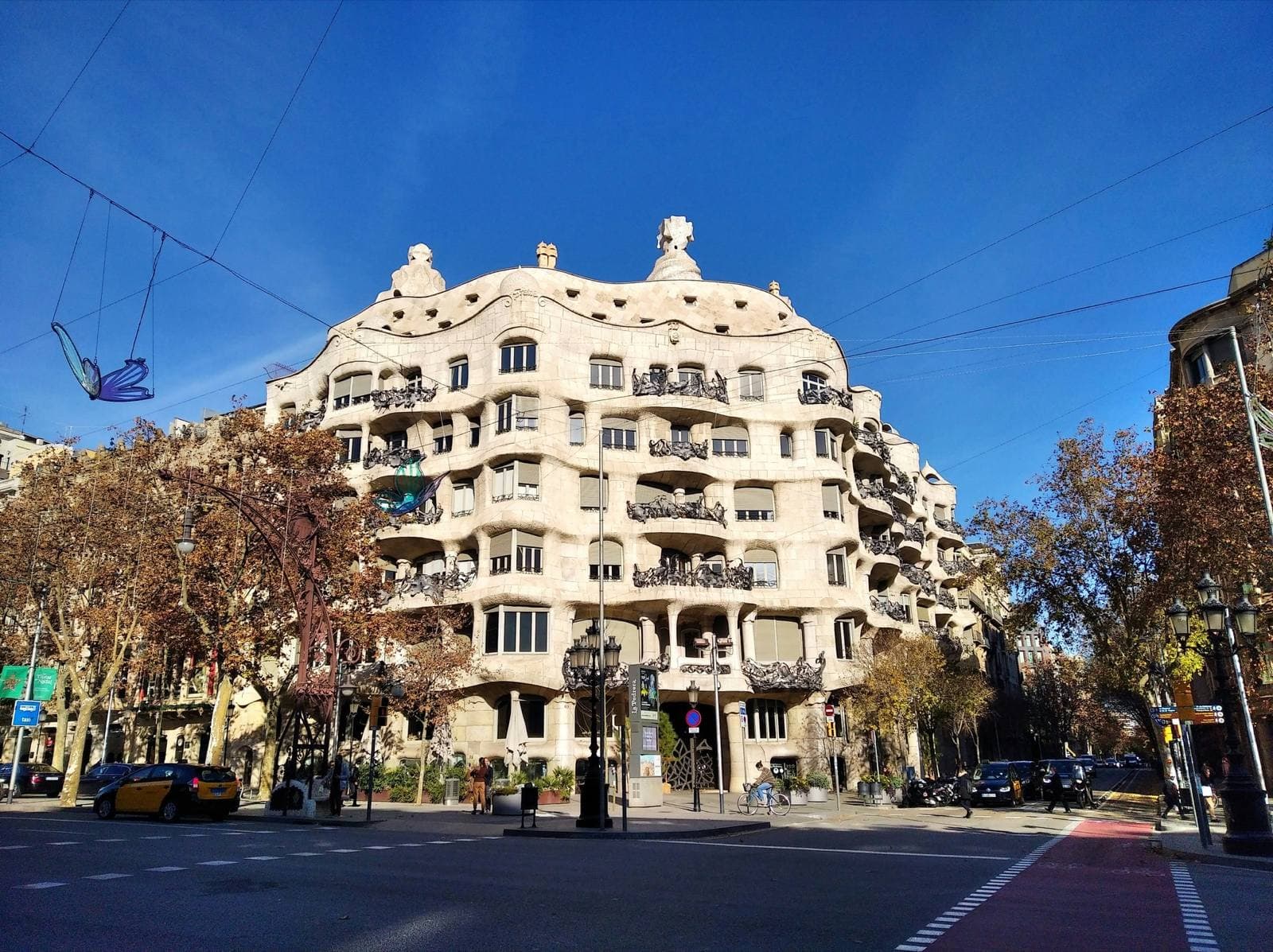
Known as La Pedrera, the quarry, for its rippling stone façade without a single straight line. Gaudí built it between 1906 and 1912, with wrought-iron balconies and a roof of chimneys that look like warriors.
Passeig de Gràcia
The great avenue of the Eixample and the showcase of Modernisme. Here the Catalan bourgeoisie commissioned its most ambitious houses, among luxury shops and Pere Falqués' Modernista streetlamps.
Manzana de la Discordia
The stretch of the Passeig de Gràcia where several architects built very different houses wall to wall. The name comes from that clash of styles competing for your gaze, with the Casa Batlló and the Casa Amatller side by side.
What's included
- A professional local guide who runs the tour in Spanish and English
- A free walking tour of about two and a half hours through the Eixample and the Passeig de Gràcia
- A small group of no more than 25 people
- Anecdotes, history and context on Modernisme and Gaudí's life
- Confirmation by WhatsApp with the exact meeting point and the guide's name
Not included
- Entrance tickets to the monuments, museums or interiors (the route sees them from the outside)
- Food and drinks
- Transport to the meeting point
- Tips or the voluntary contribution, which you decide at the end of the tour
Meeting point
Look for the yellow umbrella
Plaça de Catalunya, 2, Eixample · 08002 Barcelona
We meet at Plaça de Catalunya, number 2, in the Eixample. Look for your guide at the meeting point; we recommend arriving 10 minutes before the start time. The square is very well connected by metro, train and bus.
Reviews
3,611 reviews on Google
Trip Tours' real average rating on Google.
“Filipino traveler here. I was really amazed by the guide, Stuart. He was incredibly knowledgeable and seemed to know everything about the history of Madrid. If you are someone who loves history like me, then this tour is definitely worth it promise! He was very passionate about what he does, and you can really feel it throughout the tour. He also recommended a flamenco show to me, and it turned out to be one of the best experiences of my trip. I definitely did not regret going. 5 star for stuart!”
Google · 4 months ago
“Stuart was a wonderful guide with a wealth of knowledge of the history of Madrid. This coupled with a great presentation style, a mix of humour a little suspense and a great knowledge of food made for an absolutely fabulous tour. Highly recommend Stuart as your guide and highly recommend this tour!”
Google · a month ago
“Stu was really good! He was interesting and interactive. Explained lots about Madrid, its history, its buildings. The pace was excellent and he gave us lots of tips to explore the city some more. Highly recommended! Thanks Stu!”
Google · 11 months ago
“Had an amazing experience with Martina as our tour guide! She was great at answering any questions, very informative and gave us all great insight into the history of Madrid, its people and culture. She also gave some great recommendations for places to see, good times to visit those spots, and places to eat and drink. Would 100% recommend a tour with Martina! She’s amazing!”
Google · 4 months ago
FAQ
- Is the free tour really free?
- You book for free and pay nothing in advance. At the end, each person gives a voluntary contribution based on how much they enjoyed it; in Barcelona the usual amount is around 15 to 20 euros per person. It is not a fixed price, but it is not entirely free either: the guide makes a living from those contributions.
- How long does it last?
- The route lasts about two and a half hours, at a relaxed pace and with stops to explain each building calmly.
- What language is it in?
- The tour runs in Spanish and English. When you book you tell us your language and we confirm the matching guide.
- Do we go inside the monuments?
- No. This free walking tour sees the buildings from the outside and explains the reason behind each one. Tickets to the Sagrada Família, the Casa Batlló or La Pedrera are separate and are bought on their own if you want to visit them inside.
- Is there a lot of walking on the route?
- It is a stroll through the Eixample, a flat area with wide streets. You move at a comfortable pace between the Passeig de Gràcia and the area around the Sagrada Família, with frequent stops to listen to the explanations.