
Madrid is almost never the first stop on a trip around Europe. It usually lands in the middle of the route, after Paris or Lisbon, before Barcelona or Seville, or as a two or three night stopover to catch your breath and eat well. This guide is written for exactly that traveler: the one who arrives with a tight schedule, wants to see what matters without feeling rushed, and has no time to read ten blogs to piece a plan together. Here you will find what to prioritize depending on how many days you have, how the city is laid out by neighborhood, and how to move around so you do not lose hours in transit.
The first thing worth understanding is that Madrid is more walkable than the map suggests. The historic center, the major museums and most of the lively areas sit inside a rectangle you can cross on foot in thirty or forty minutes from side to side. That changes how you plan: you do not need to string together metro rides or taxis to get from Puerta del Sol to the Prado Museum, and some of the best hours of the day are the ones you spend walking from one place to the next, with no fixed plan.
The second idea is that Madrid rewards those who match their pace to the city rather than the other way around. Lunch is late, dinner is later, and the streets do not empty out until well into the night. If you come from cities where everything closes at nine, make the most of it: the hottest midday hours, especially in summer, are perfect for museums and terraces, and dusk is when the city looks its best. With that in mind, let us get to the concrete plans.
Madrid in one day
A single day in Madrid covers more than you would expect if you focus on the central axis and do not try to see everything. The trick is to pick one area for the morning, one for the afternoon and let go in advance of whatever falls outside. There is no harm in leaving things out: Madrid is one of those cities you come back to.
Start early in the historic quarter. Puerta del Sol, Plaza Mayor and Plaza de la Villa give you the old heart of the city in a short walk, and from there you head down to the Royal Palace and Almudena Cathedral, which form the most impressive monumental ensemble in the city. If you want to understand what you are looking at rather than photograph it without context, this is where our free tours through the historic quarter fit perfectly: in a couple of hours they set out the history of the Habsburgs, the squares and the corners you would otherwise walk right past.
For the afternoon, cross over to the museum side. With only one day, the sensible thing is to choose a single one and take your time. The Prado is the safe bet if classical painting appeals to you; the Reina Sofía if you prefer twentieth century art and want to see Picasso's Guernica. End the day in Retiro Park or up on a rooftop terrace with views for sunset, and have dinner in La Latina or Huertas without watching the clock.
- • Morning: Sol, Plaza Mayor, the Royal Palace and Almudena, better with a free tour that gives you context
- • Lunch: cocido stew, a fried squid sandwich or a set lunch menu in the center
- • Afternoon: a single big museum, the Prado or the Reina Sofía
- • Sunset: Retiro, the Temple of Debod or a rooftop with views
- • Evening: tapas and beers around La Latina or Huertas, no rush
Madrid in 2 or 3 days
With two or three days you can breathe. You are no longer racing the clock and you can split the monuments, the art and the neighborhoods across separate days, which is how you truly enjoy the city. This is the ideal length for a stopover within a European route, because you take in all of Madrid without it turning into a sprint.
Give the first day to the historic center and the Royal Palace axis, at an easy pace, going into whatever appeals to you. The second, to art: the triangle of the Prado, the Reina Sofía and the Thyssen sits so close together that you can combine two museums in a day if you like painting, or keep the afternoon free for Retiro, which is right next door. The third day, if you have it, is the perfect moment to leave the city or to dive into the neighborhoods with the most character.
If you have that third day, you have two clear options and both are good. One is to stay in Madrid and wander Malasaña, Chamberí or La Latina, markets included. The other is to take a getaway: the day trips to Toledo, Segovia and Ávila leave and return the same day without complicating your accommodation, and add three World Heritage cities to your trip, all less than an hour and a half away.
- • Day 1: the Habsburg historic quarter and the Royal Palace
- • Day 2: the Paseo del Arte museums and Retiro Park
- • Day 3, option A: neighborhoods (Malasaña, Chamberí, La Latina) and markets
- • Day 3, option B: a day trip to Toledo, Segovia or Ávila
- • Spread your dinners across different areas so you do not repeat the same vibe
The Habsburg historic quarter
The Madrid of the Habsburgs is the neighborhood that shaped the capital when Philip II moved the court here in 1561. It is the oldest part, the one of narrow lanes, stone squares and brick buildings with slate spires, and it is the best place to start understanding the city.
The natural route links the Plaza Mayor, enclosed and arcaded, with the Plaza de la Villa, Almudena Cathedral and the Royal Palace, which with its more than 3,000 rooms is one of the largest palaces in Western Europe. In between you find the Plaza de Oriente, the Sabatini Gardens and streets like Cava Baja, which by day is history and by night is one of the most storied tapas routes in Madrid.
This is the stretch of the city where a guided visit completely changes what you take away. The facades and the squares hold centuries of intrigue, markets, executions and royal celebrations that are invisible at first glance. That is why our free tours through the historic quarter focus right here: they give you the thread that connects each square to the next and spare you the feeling of staring at stones without knowing what they are.
- • Plaza Mayor: the great arcaded hall of old Madrid
- • The Royal Palace and Almudena Cathedral, the main monumental ensemble
- • Plaza de la Villa and Plaza de Oriente, quieter and full of charm
- • Cava Baja and Cava Alta for tapas as the evening sets in
- • Mercado de San Miguel, next to the Plaza Mayor, for a bite
The museum triangle
The so-called Paseo del Arte gathers three of the finest art museums in the world within little more than a kilometer, and that concentration is a gift for anyone short on time. You can see two museums in a day without taking any transport, simply walking along the Paseo del Prado between one and the other.
The Prado Museum is the essential one if you only go into a single museum. It holds the great collection of Spanish and European painting, with Velázquez, Goya, El Greco and a roster that could fill hours. The Reina Sofía is the museum of twentieth century art and home to Picasso's Guernica, along with works by Dalí and Miró. The Thyssen-Bornemisza completes the triangle with a journey from Gothic to pop art that fills the gaps the other two leave.
A planning tip: do not try to see all three in depth on a short stay, because you end up overwhelmed. Choose according to your taste and book your ticket in advance to skip the line, especially in high season. Many of these museums also have free entry windows at the end of the day, which are worth it if your budget rules the trip, though they tend to be busier.
- • Prado: classical Spanish and European painting, the one not to skip
- • Reina Sofía: twentieth century art and Picasso's Guernica
- • Thyssen-Bornemisza: from Gothic to pop, ideal as a complement
- • Book online to avoid lines in high season
- • Check the free evening windows if you are traveling on a tight budget
Neighborhoods with soul: Malasaña, La Latina and Chamberí
Beyond the monumental circuit, much of Madrid's character plays out in its neighborhoods. If you have a third day, or you simply want to alternate the museums with a bit more street life, this is where you will feel the real pulse of the city.
Malasaña is the young, alternative neighborhood, birthplace of the Movida madrileña of the eighties. Design shops, specialty coffee bars, music and constant street life around the Plaza del Dos de Mayo. Right beside it is Chueca, the hub of nightlife and outdoor terraces. La Latina, by contrast, is quintessential old-school Madrid: on Sundays it revolves around the Rastro, the most famous open-air flea market in the city, and its taverns are a must for tapas.
Chamberí sits a little further north and is the classic residential neighborhood, elegant and quiet, with stately streets, local markets and a food scene that many people in Madrid prefer to the one downtown. It is perfect for an unplanned stroll, away from the tourist crowds, and for eating where the locals eat.
- • Malasaña: the Movida, design and specialty coffee, centered on the Plaza del Dos de Mayo
- • Chueca: terraces, atmosphere and nightlife, right next to Malasaña
- • La Latina: the Rastro on Sundays and the best taverns for tapas
- • Chamberí: stately and quiet, ideal for eating like a local
- • Pair a neighborhood with a nearby museum so you do not tire of the same thing
Parks and viewpoints
Madrid has no sea, but it has sky, and it makes the most of it with wide parks and rooftops from which you can see the whole city. Slipping in a moment of green or height between visits is the best way to slow down without losing the day.
Retiro Park is the lungs of the center and sits right next to the museums, so it fits perfectly after a morning of art. It has the boating lake, the Palacio de Cristal and avenues to stroll or sit down. To the west, the Temple of Debod is a genuine Egyptian temple, a gift from Egypt to Spain, set in an elevated park that offers one of the best sunsets in the city, with the open sky behind it and no entry fee.
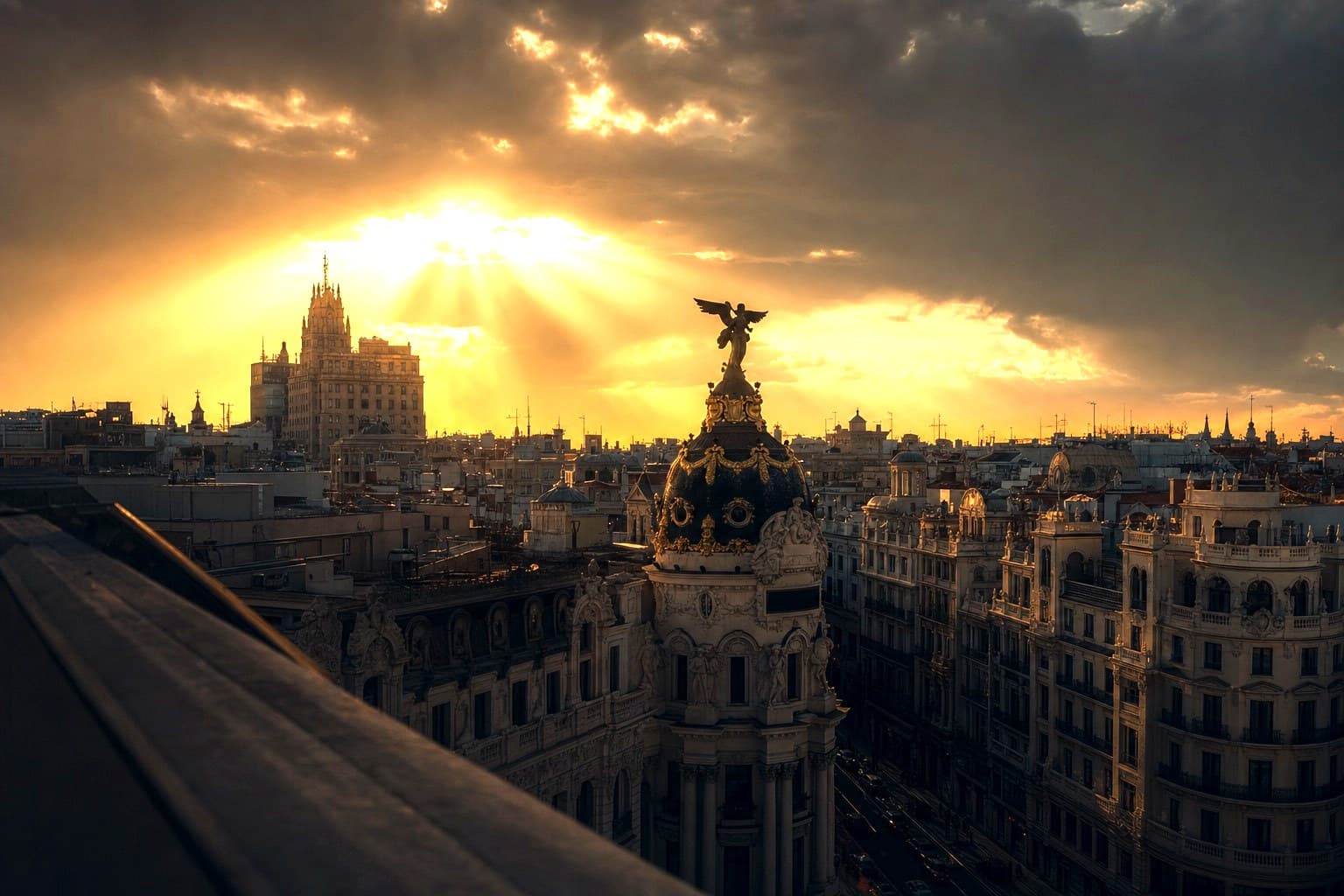
To look at Madrid from above, the city has filled up with rooftops. Some are in hotels, others in public buildings like the Círculo de Bellas Artes, and almost all ask for a drink or a small entry fee. They are worth it at dusk, when the light drops and the domes of the center light up.
- • Retiro Park: the boating lake, the Palacio de Cristal and shade next to the museums
- • Temple of Debod: an Egyptian temple and the best free sunset
- • Círculo de Bellas Artes: a rooftop with 360-degree views over the center
- • The Sabatini Gardens and Plaza de Oriente, beside the Royal Palace
- • Casa de Campo and the cable car if you want green on a large scale and a bit of height
How to get around and when to go
Getting around Madrid is simple and cheap compared with other European capitals. The center is walkable and for everything else the metro is fast, clean and reaches almost everywhere, including Barajas airport. If you are going to use it several times, the rechargeable Multi card pays off, and from the airport you have to add a small surcharge to the standard fare. Buses cover what the metro does not, and at night the buhos, the night lines, keep running.
From the airport you have three clear options: the metro, the Airport Express that connects with Atocha, or a taxi with a fixed flat fare to the center, which is convenient if you arrive with luggage or in the early hours. Any of the three drops you in the center in a little over half an hour.
As for when to come, spring and autumn are the best seasons, with pleasant temperatures for walking all day. Madrid summers are dry and hot, with days that top 35 degrees, so it pays to start early, take refuge in the museums at midday and head out again as the sun goes down. Winter is cold but bright, with many clear-sky days, and August is still the month when part of the city packs its bags, though anything geared to tourists stays open.
- • The center is best on foot: save the metro for the long distances
- • A rechargeable Multi card for metro and bus, with a surcharge from the airport
- • From the airport to the center: metro, Airport Express or a taxi with a flat fare
- • Spring and autumn, the ideal seasons for walking without any strain
- • In summer, museums at midday and the streets at dusk because of the heat
Day trips from Madrid
One of the great advantages of Madrid as a base is its position in the center of the country. In less than an hour and a half you have several historic cities that work wonderfully as a same-day round trip, without having to change accommodation or unpack. If your European route leaves you an extra day, use it to get out of town.
The day trips to Toledo, Segovia and Ávila are the three classic choices, and each has its own character. Toledo, the former capital, is the city of the three cultures, with its cathedral, its medieval lanes and the legacy of El Greco. Segovia dazzles with its Roman aqueduct of almost 2,000 years and its fairy-tale Alcázar perched on the rock. Ávila preserves one of the most complete medieval walls in Europe, a stone belt you can walk all the way around.
If you have only one day to get away, pick one. Toledo is the most well-rounded for variety and proximity, Segovia the most photogenic, and Ávila the most compact. With two days out, the combination of Segovia and Ávila works well because they are relatively close to each other. Going on an organized excursion saves you the logistics of timetables and transport, which is exactly what you appreciate when you are passing through and do not want to lose time juggling trains.
- • Toledo: the city of the three cultures, cathedral and El Greco, the most complete
- • Segovia: Roman aqueduct and Alcázar, the most spectacular in photos
- • Ávila: one of the best-preserved medieval walls in Europe
- • All three are less than an hour and a half from Madrid, a round trip in a day
- • With an organized excursion you forget about timetables, tickets and transport
Frequently asked questions
- How many days do I need to see Madrid?
- With one day you can see the historic center and one major museum if you focus on the central axis. Two or three days is ideal for separating the monuments, the art and the neighborhoods without rushing, and for allowing yourself a day trip to Toledo, Segovia or Ávila. Four days already give you room for everything at an easy pace.
- Is a free tour worth it if I am short on time?
- Yes, precisely because you are short on time. Our free tours through the historic quarter set out the history of the squares, the Royal Palace and the Habsburgs in a couple of hours, which saves you from wandering without context and helps you decide what to come back to later on your own. It is the most efficient way to understand the city when you arrive.
- Can I take a day trip from Madrid?
- Yes, and it is well worth it if you have a free day. Toledo, Segovia and Ávila are less than an hour and a half away, so they leave and return the same day without changing accommodation. The day trips to Toledo, Segovia and Ávila sort out the transport and the timetables for you, which is what would take the most time to organize on your own.
- What is the best time to visit Madrid?
- Spring and autumn are the best seasons, with pleasant temperatures for walking all day. Summer is hot and dry, with days that top 35 degrees, so it pays to start early and take refuge in the museums at midday. Winter is cold but very bright and with fewer crowds.
- Do I need a car or public transport to get around?
- You do not need a car. The historic center, the museums and the lively areas are all walkable, and for the long distances the metro is fast and cheap. From the airport you have the metro, the Airport Express to Atocha or a taxi with a flat fare, and any of them drops you in the center in a little over half an hour.
- How does Madrid fit into a trip around Europe?
- Madrid works very well as a two or three night stopover in the middle of a trip. It is well connected by high-speed train and by air with the rest of Spain and Europe, it is mostly walkable, and it offers both major museums and day trips to World Heritage cities. It is a stop that adds to your trip without complicating the logistics.