In this article (8 sections)
Trip Tours is a walking-tour operator based in Madrid. In Lisbon we do not run our own guides: we work with trusted affiliated guides, and on our city page we gather the free tours we recommend, with their languages, times and starting points. Here we explain how the system works so you arrive knowing what to expect and pick the right first walk through Alfama, Baixa or Belém.
What a free tour is and how it works
A free tour is a guided group walk that you book without paying upfront and where you contribute at the end based on what the walk gave you. The word free means there is no fixed price at booking, not that the guide works for nothing: at the end, each person hands over a voluntary contribution, and those contributions are what a professional guide who knows the city inside out lives on.
The mechanics in Lisbon are the same as in any European capital. You choose the tour and the time, book online stating how many people are coming, receive a confirmation with the exact meeting point and turn up a few minutes early. The guide checks the list, leads the walk, which usually lasts between two and two and a half hours, and says goodbye to the group at the end. That is the moment to say thank you with your contribution. Booking is free and, if your plans change, you can cancel at no cost.

Do it with a guide
Unmissable Lisbon Free Tour
Dive into the heart of Lisbon with our Unmissabel Lisbon Free Tour, a whirlwind journey on which you will discover 3,000 years of history and...
How much to leave and how you pay
This is the question everyone asks, and it deserves a clear answer. A free tour is not entirely free, but nor is it a matter of dropping a coin and walking away: the usual benchmark is 15 to 20 € per person for a two to two and a half hour walk you enjoyed. It is the same range as in Madrid, Seville or Barcelona, and Lisbon, although somewhat cheaper for restaurants and accommodation, does not fall outside it because the guide's work is the same.
The contribution is always per person, not per group, and is handed directly to the guide at the end. Cash in small notes is the most convenient option, since many guides have no way of giving change; it is also increasingly common for guides to accept mobile or contactless card payments, but do not take it for granted and ask at the start. If the tour did not win you over, leaving less is legitimate: that is precisely the logic of the model.
Where free tours in Lisbon start
Free tours of the centre set off from three squares that are easy to find. The most common is Praça do Comércio, the vast square open to the Tagus that was once the city's gateway and is now the kilometre zero of the Pombaline Baixa; groups usually gather by the equestrian statue or under the Rua Augusta arch. The second is Rossio, the square with the wavy pavement and two fountains that hinges Baixa, Avenida da Liberdade and the climb up to Alfama. The third is Largo Camões, on the border between Chiado and Bairro Alto, where the bohemian Lisbon tours and many of the night walks begin.
The exact spot and time always come in the confirmation email, so there is no need to guess. Arrive with ten or fifteen minutes to spare: these are busy squares and sometimes several groups gather at once. Look for your guide by their sign or umbrella and, if you cannot see them, the email usually includes a contact phone number.
Book free, leave a contribution at the end

Which free tours there are and which to choose first
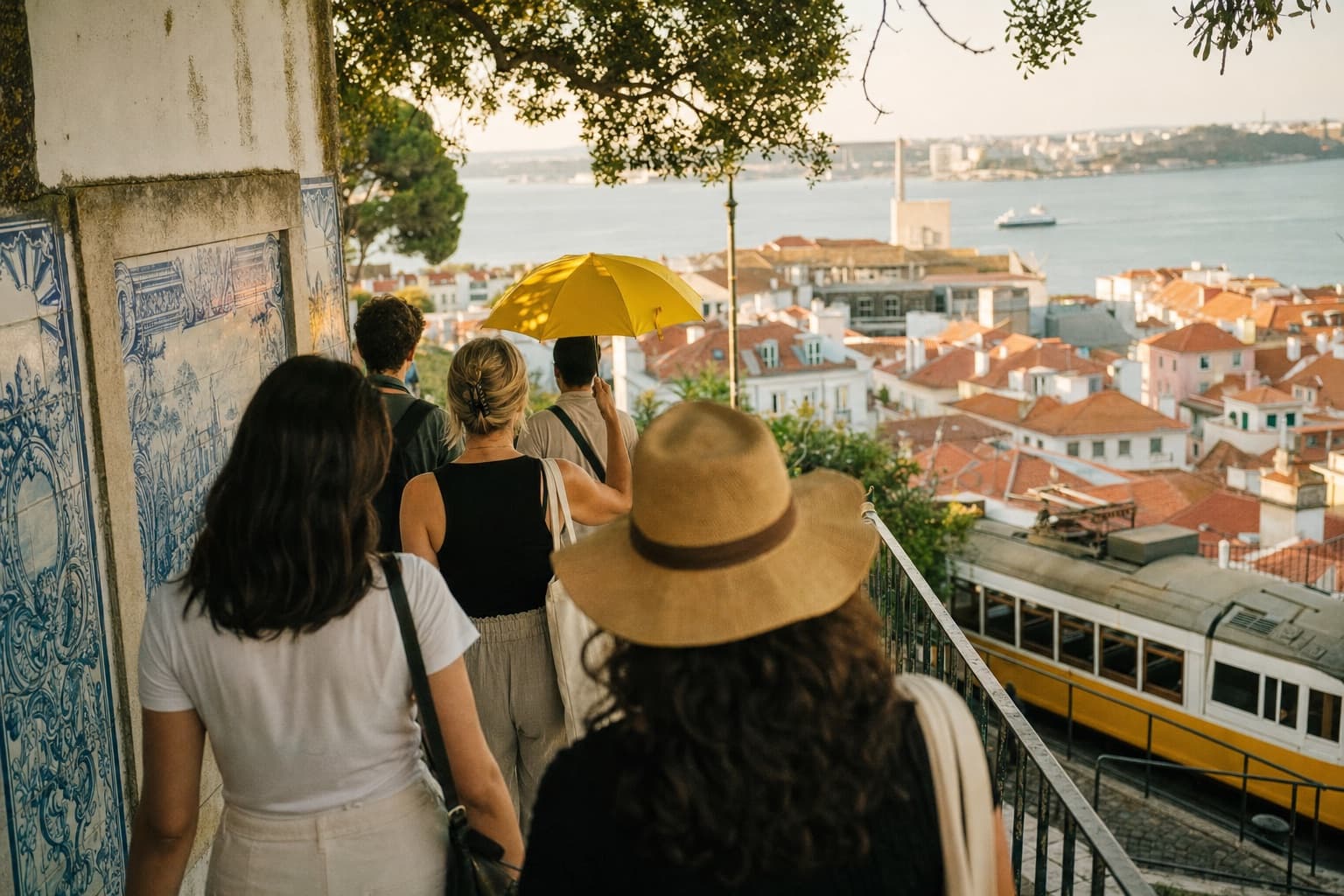
Lisbon has a wide range, and on our city page we gather sixteen free tours. The classic is the essential Lisbon walk: Pombaline Baixa, Praça do Comércio, Rossio, Chiado and the climb towards Alfama, the route that gives you the mental map of the city in two hours. The Alfama tour focuses on the oldest quarter, the one that survived the 1755 earthquake when Baixa collapsed: the Sé cathedral, the Santa Luzia and Portas do Sol viewpoints, alleys with washing hanging out and São Jorge Castle seen from outside. The bohemian Lisbon walk covers Chiado, Bairro Alto and Príncipe Real, the city of cafés, bookshops and nightlife. And there are night routes combining legends and lights over the river.
If it is your first time, start with the essential walk or with Alfama, depending on whether you want the overview or the quarter with the most character. Save Bairro Alto and the night tour for day two, once you have your bearings. Belém is a chapter of its own: it lies about six kilometres west of the centre, concentrates the Belém Tower, the Jerónimos Monastery, the Monument to the Discoveries and the bakery behind the pastéis de Belém, and has its own free tours. No walk from the centre reaches it on foot; you get there on tram 15E or by train from Cais do Sodré, and it deserves half a day.
Which languages are available and how to book
English is the default language in Lisbon, with departures throughout the day, so English speakers have the widest choice. Spanish comes close behind, because the city receives huge numbers of travellers from Spain and Latin America, with morning and afternoon slots most of the year. French and Italian free tours also run, with fewer weekly departures, so if you prefer those languages it pays to book further ahead and filter by language when you search.
Booking takes a minute and costs nothing: you choose the tour and the time, state how many people are coming and the language, and receive an email with the meeting point, the exact time and how to recognise the guide. On the day you turn up ten or fifteen minutes early and show your booking. If in the end you cannot make it, cancel through the link in the email: the guide has paid a commission for your place and, if you let them know, can give it to someone else.
What the free tour does not include, and what about fado
A free tour is a street walk with a guide: it includes the route and the explanations, not the tickets. In Lisbon that means São Jorge Castle is seen from outside and from the viewpoints, the interiors of the Jerónimos Monastery and the Belém Tower are visited on your own, and the Santa Justa lift, with its permanent queue, is not part of it either. That is exactly what the tour is for: deciding which tickets are worth the money and which sights are just as enjoyable from the street.
Fado is not part of the tour either, and it is worth clarifying what it is, because it causes confusion. Fado is music, not a neighbourhood: a melancholic song accompanied by the Portuguese guitar that UNESCO listed as intangible heritage in 2011. You hear it in the fado houses of Alfama, Mouraria and Bairro Alto, usually with dinner or a drink. Alfama guides often explain its history and point out a few houses, and that recommendation is gold, but you book the session yourself.
Tips to make the most of it
Lisbon is walked uphill and downhill, over calçada, the polished white cobblestone that turns slippery in the rain. Wear comfortable shoes with grippy soles and forget smooth-soled sandals. The Alfama and Bairro Alto tours include stairs and ramps; if someone in your group has reduced mobility, choose the Baixa route, which is flat.
Tram 28 is lovely, but it is always packed and is the pickpockets' favourite spot: if you ride it, do so first thing in the morning with your bag in front of you. The same goes for the Santa Justa, Bica and Glória lifts, which charge a fare and build up queues; with a decent pair of legs you get there just the same. In summer the midday sun is fierce, so prefer morning or late-afternoon slots; in winter it rains on and off and a light raincoat comes in handy. Spring and autumn are the best seasons: mild temperatures, fewer crowds and perfect light over the river.
Frequently asked questions
- Are free tours in Lisbon really free?
- Not entirely. Booking costs nothing and there is no entry price, but at the end each person leaves a voluntary contribution for the guide. The guide has paid a commission for your place before starting, so that contribution is how they get paid.
- How much do you leave as a contribution on a free tour in Lisbon?
- The usual benchmark is 15 to 20 € per person for a two to two and a half hour walk you enjoyed. It is per person, not per group, and is handed to the guide at the end, in cash or, increasingly, by mobile or contactless card if the guide accepts it.
- Where do free tours in Lisbon start?
- The centre tours set off from Praça do Comércio, Rossio or Largo Camões, depending on the route. The Belém tours start in the neighbourhood itself, by the Jerónimos Monastery or the Tower. The exact spot and time come in the confirmation email; arrive ten or fifteen minutes early.
- Are free tours in Lisbon in English?
- Yes, English is the default language and most departures run in it, throughout the day and all year round. Spanish is almost as widely available, and French and Italian tours also run with fewer weekly slots, so for those it is worth booking ahead.
- Does the free tour go into São Jorge Castle or the monasteries?
- No. The castle is seen from outside and from the viewpoints, and the interiors of the Jerónimos Monastery, the Belém Tower and the Santa Justa lift are paid visits you make on your own. The tour helps you decide which ones deserve the ticket.
- Can you visit Belém on a free tour?
- Yes, but on a dedicated Belém tour, not from the centre: it lies about six kilometres to the west. You get there on tram 15E or by train from Cais do Sodré, and it is worth setting aside half a day for the Tower, the Jerónimos, the Monument to the Discoveries and the pastéis.