In this article (7 sections)
Westminster: postcard London
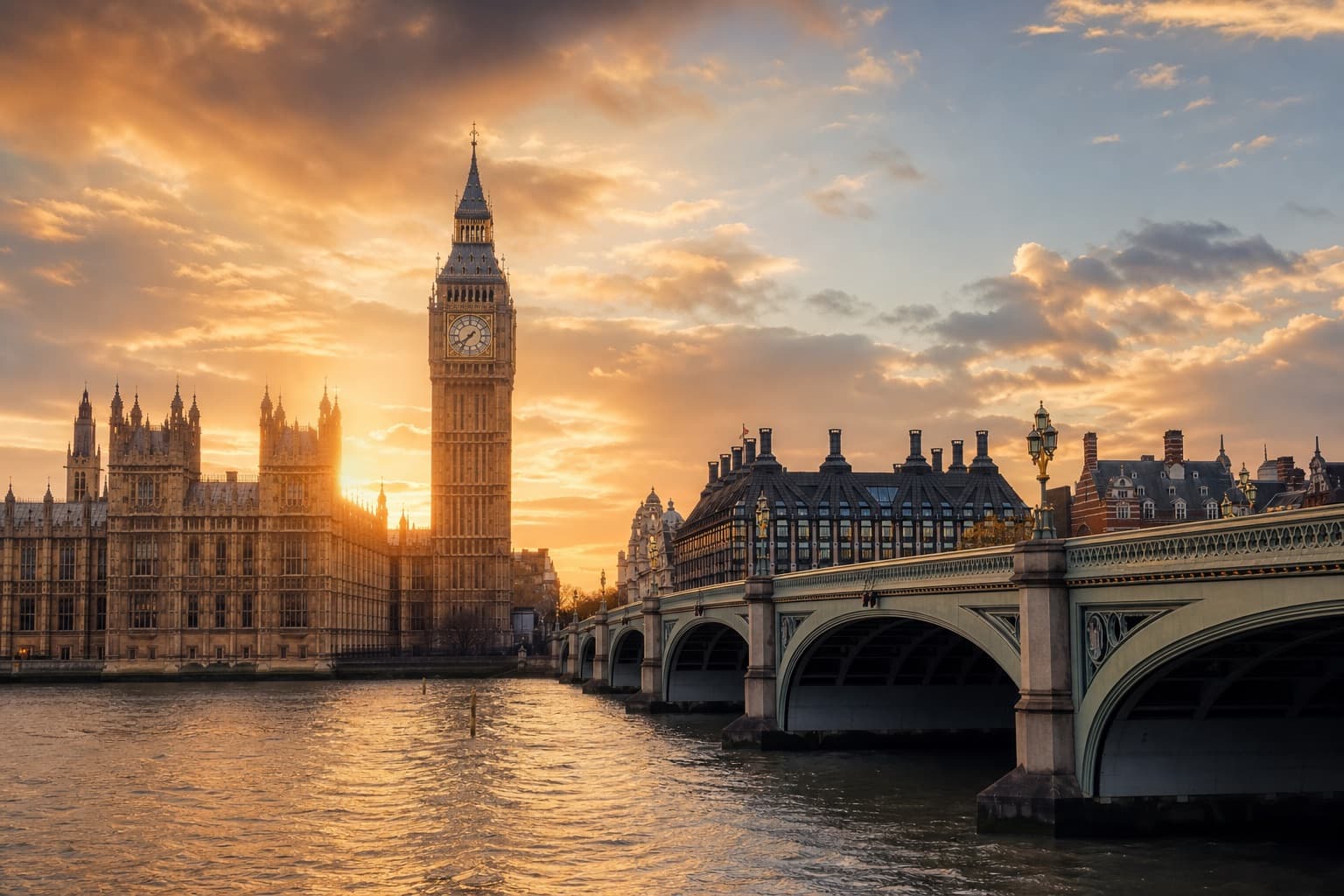
Almost everyone starts here, and it makes sense. In Parliament Square you have Big Ben (the tower is called Elizabeth Tower), the Palace of Westminster with the Houses of Parliament and Westminster Abbey, where the kings are crowned and half the country is buried. It is a small square you can walk around in a quarter of an hour, though it is worth stopping to look up slowly.
From there you head up Whitehall, the avenue of British power. You pass in front of Downing Street (number 10 is the prime minister's residence; you will see the gate and the police) and Horse Guards, with its mounted guards. The street opens onto Trafalgar Square, presided over by Nelson's Column and with the National Gallery at the far end. If you turn toward St James's Park, in a few minutes you reach Buckingham Palace along the promenade of The Mall. The easiest way to make sense of all this history before going on your own is to start with a free tour of London, which usually sets off precisely in this area.

Do it with a guide
The Original Free Tour of London
From the ancient coronations in Westminster Abbey to the harshness of the Blitz and the resilience of Winston Churchill, the history of...
The West End: Soho, Covent Garden and the theaters
North of Trafalgar Square begins the London of bright lights. Piccadilly Circus, with its screens and the statue of Eros, is the most photographed junction, and from there Regent Street draws its curve of stately facades up to Oxford Circus. A step away are Carnaby Street and the Soho neighborhood, with its bars, its Chinatown around Gerrard Street and corners like Neal's Yard, a tiny courtyard painted in colors near Seven Dials.
Covent Garden is the other must-stop: its old covered market, the square with musicians and jugglers, and the shops around it. Very close you have Leicester Square, the bookshops of Charing Cross Road and the theaters of Shaftesbury Avenue, the heart of the great musicals. This whole area is walked without noticing, hopping from one street to the next.
The City: a thousand years of history and skyscrapers
The City is the financial district and, at the same time, the oldest London. It is dominated by St Paul's Cathedral, with Christopher Wren's dome that survived the Blitz. Nearby is The Monument, the column that recalls the Great Fire of 1666, which you can climb from the inside, and Leadenhall Market, a covered Victorian market you may recognize from the Harry Potter films.
The Bank junction brings together the Bank of England and the Royal Exchange, surrounded by modern towers with nicknames of their own, like the Walkie-Talkie, which hides the Sky Garden (a viewpoint with a garden that you enter for free by booking ahead). Walking toward the river you reach the Tower of London, the medieval fortress where the Crown Jewels are kept, and Tower Bridge, that drawbridge of two towers that people often confuse with London Bridge, which is actually the plain one next door.
Book free, leave a contribution at the end

The south bank of the Thames: from the London Eye to Borough Market
Cross the river and walk east along the south bank, one of the best pedestrian routes in the city. You start beside the London Eye and the County Hall building, carry on past the Southbank Centre and go in front of the Tate Modern, the contemporary art museum set up in an old brick power station. From its door leads the Millennium Bridge, the pedestrian walkway that points straight at St Paul's, on the other side of the water.
From there the walk gets tempting. There is the reconstruction of Shakespeare's Globe, the wooden Elizabethan theater, and a little further on Borough Market, the most famous food market in London, ideal for a lunch stop. Beside it rises The Shard, the sliver-of-glass skyscraper that marks the southern skyline. It is a flat stretch, almost all at river level.
Beyond the center: Notting Hill and Greenwich
When you want to leave the monumental core, there are two areas that repay the journey without changing register completely. Notting Hill, to the west, is the London of pastel-fronted houses and the Portobello Road antiques market, which fills with stalls on Saturdays; it is also the neighborhood of the famous August carnival. It is strolled at a leisurely pace, among second-hand shops and quiet streets that have little to do with the bustle of the West End.
Greenwich is worth half a day and is best enjoyed arriving by boat along the Thames. There you have the Royal Observatory with the prime meridian, where you can put one foot in each hemisphere, the Cutty Sark clipper and the Old Royal Naval College. From the top of Greenwich Park you have one of the best views of the Canary Wharf skyline. It is a calmer, greener London. And if what you are after is markets, street art and music, the more alternative neighborhoods like Camden, Shoreditch or Brixton have their own route apart, because they ask for another pace and a day to themselves.
Practical tips for walking London
Bring comfortable shoes and dress in layers: the weather changes fast and a thin raincoat can save your day. For the long stretches between neighborhoods, forget about buying single tickets and pay with a contactless card or an Oyster straight at the gate of the Tube and the bus; the system charges you the fairest fare. On the escalators you stand still on the right and leave the left clear, and when crossing look to your right first, because they drive on the opposite side to Spain (you will see look right painted at many crossings).
Take advantage of the fact that London has great museums with free admission, like the British Museum, the National Gallery, the Tate Modern or the Natural History Museum, to rest from the pavement without spending. And if it is your first day, a free tour of London helps you find your feet: it is booked online, sets off almost always near Westminster or Trafalgar Square and, at the end, you recognize the guide's work with a contribution of between 15 and 20 euros per person depending on how much the walk gave you.
Frequently asked questions
- How many days do I need to see London on foot?
- With three full days you cover the essentials on foot: one day for Westminster and the West End, another for the City and the south bank of the Thames, and a third to slip off to Notting Hill or Greenwich. If you have more time, you can add the great museums and parks like Hyde Park without wearing yourself out.
- How much does a free tour of London cost?
- The booking costs nothing and, at the end, each participant gives the guide a contribution that usually runs from 15 to 20 euros per person depending on how useful they found it. It is an affordable way to get your bearings on the first day and to have a local lay out the history for you before you explore the city on your own.
- How do I get between the more distant neighborhoods?
- For Notting Hill or Greenwich the Tube and the DLR are the most practical. Pay with a contactless card or an Oyster straight at the gate, without buying single tickets, and the system applies the cheapest daily fare. To Greenwich you can also go by boat along the Thames, which is a plan in itself.
- What can you visit for free in London?
- Admission is free at many great museums, like the British Museum, the National Gallery, the Tate Modern, the Natural History Museum and the Victoria and Albert. Also free are the Sky Garden viewpoint (booking ahead), the changing of the guard at Buckingham Palace and, of course, strolling around Parliament Square, the south bank or Borough Market.