In this article (7 sections)
The start: Cathedral, Giralda and the Patio de los Naranjos
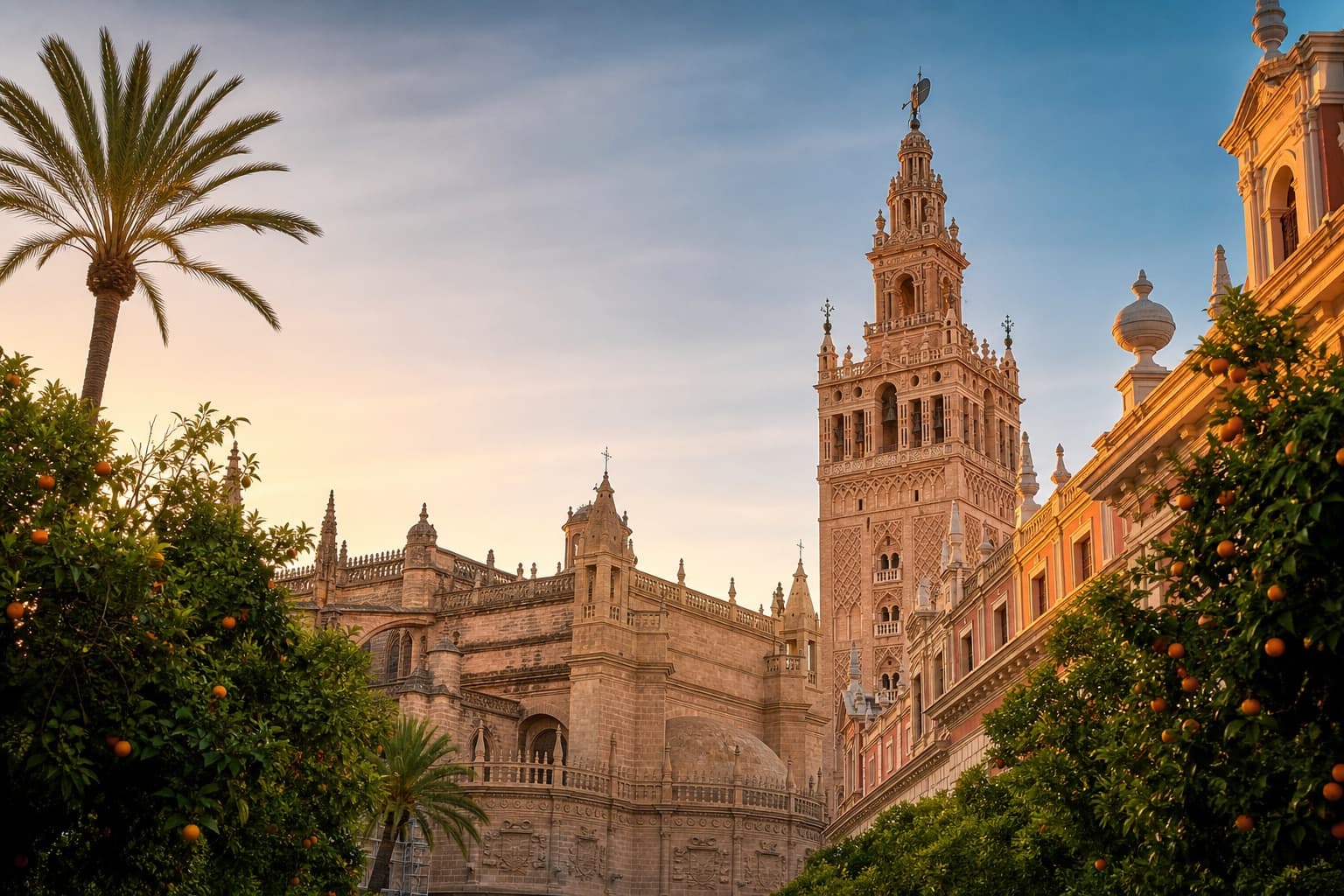
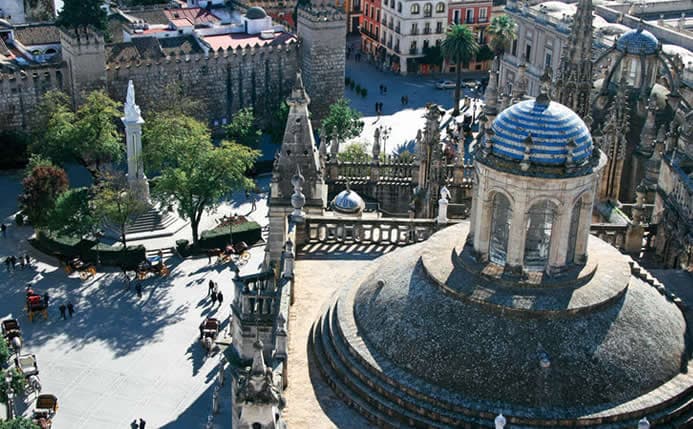
The natural starting point is Seville Cathedral, the largest Gothic temple in the world and home to the tomb attributed to Christopher Columbus. Its bell tower, the Giralda, was the minaret of the old Almohad mosque: the first two thirds are from the twelfth century and the Renaissance top with the Giraldillo came later. You go up by ramps, not stairs, because it was designed to be climbed on horseback, and from the top you have the best view of the old town.
Before going in, cross the Patio de los Naranjos, the old ablutions courtyard of the mosque, and step out onto the Plaza del Triunfo, where the Cathedral, the Archivo de Indias and the gate of the Alcázar sit side by side. It is kilometer zero of monumental Seville and the best place to get your bearings before going on.
Do it with a guide
Seville Monumental Free Tour
The Cathedral and the Giralda, the Royal Alcázar, the Archive of the Indies and the Torre del Oro: Golden Age Seville.
The Real Alcázar and the Santa Cruz maze
Right across from it stands the Real Alcázar, a palace in use for more than a thousand years and still the royal family's residence when they visit the city. It blends the Mudéjar of King Pedro I with Gothic, Renaissance and Romantic additions; do not miss the Patio de las Doncellas or the gardens, which appeared in Game of Thrones as the gardens of Dorne. It is worth buying your ticket online in advance, because the box-office line can eat up half a morning.
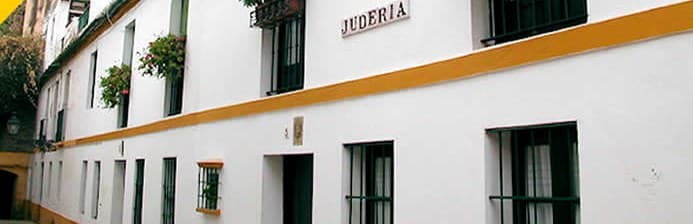
On the way out, get properly lost in the Santa Cruz quarter, the old Jewish quarter. Streets like Mateos Gago, the Callejón del Agua or the Plaza de Doña Elvira are narrow on purpose, to give shade, and they open onto corners like the Plaza de Santa Cruz or the Hospital de los Venerables. Here it is easy to lose your sense of direction, and that is exactly the charm. Every corner also hides its own legend, and the stories of the quarter are worth a themed walk of their own; on this route we keep the atmosphere and head on toward the river.
From the Arenal to the Guadalquivir: Torre del Oro and La Maestranza
From Santa Cruz you head down toward the river through the Jardines de Murillo and the Arenal quarter, the old port of the Indies. The landmark is the Torre del Oro, a thirteenth-century Almohad watchtower that was part of the wall and kept an eye on traffic on the Guadalquivir. Today it houses a small naval museum and marks the start of the riverside walk.
A few meters away you have the Plaza de Toros de la Real Maestranza, one of the oldest bullrings in Spain, and the Hospital de la Caridad, with works by Murillo and Valdés Leal. This stretch of the Paseo de Colón is, moreover, the best viewpoint toward Triana, on the other side of the water.
Book free, leave a contribution at the end
Crossing to Triana over the Isabel II bridge
The Isabel II bridge, which everyone simply calls the Triana bridge, is the oldest of those still standing over the Guadalquivir in the city. Cross it and you change worlds: Triana was a quarter of potters, sailors and flamenco singers, and it still shows it off. As soon as you arrive you have the Mercado de Triana, built over the remains of the castle of San Jorge, which was the seat of the Inquisition.
Walk along Calle Pureza to the Capilla de los Marineros, home of the Esperanza de Triana, and then drop down to Calle Betis, the row of colorful houses facing the river that appears in every photo. If ceramics interest you, the streets Alfarería and San Jorge still keep workshops that have run for generations. Many free tours of Seville finish right around here, and it is no coincidence: closing the walk watching the sunset over the river from Betis is hard to beat.
The monumental center: Sierpes, El Salvador and Las Setas
If instead of crossing the river you would rather head toward the center, Calle Sierpes and Calle Tetuán have been the commercial backbone for centuries, always pedestrian and always packed. They open onto the Plaza Nueva, presided over by the City Hall, and a step away lies the Plaza del Salvador, with the collegiate church of El Salvador, the second-largest temple in the city after the Cathedral.
A little further north, in the Plaza de la Encarnación, the Metropol Parasol awaits, which the people of Seville call Las Setas (the mushrooms). It is the largest wooden structure of its kind in the world and its undulating viewpoint offers a different view of the old town, more of rooftops and bell towers than of postcards. Below it the Roman ruins of the Antiquarium are preserved.
Plaza de España and the breather of the Parque de María Luisa
No first visit is complete without the Plaza de España, built for the 1929 Ibero-American Exposition. Its canal, its bridges and the tiled benches dedicated to each Spanish province have made it the most photographed corner of the city, and it has also served as a set for Star Wars and Lawrence of Arabia. It sits a little apart from the old town, about a fifteen-minute walk from the Cathedral, but the detour is worth it.
The square opens onto the Parque de María Luisa, the great green lung of Seville, with the Plaza de América and its museums at the far end. It is the ideal place to end the day in the shade, above all if you visit the city between May and September, when the heat forces you to plan your walk around the good hours.
Frequently asked questions
- How many days do I need to see Seville on foot?
- For the essentials of this route, two full days work well: one for the Cathedral, the Alcázar and Santa Cruz, and another for the Arenal, Triana and the Plaza de España. With three days you can go into the monuments without stress, since they take their time for queues and visits. The whole route fits on foot, because from the northern to the southern end of the old town is barely a thirty-minute walk.
- How does a free tour of Seville work and how much does it cost?
- It is a walking tour you book with no payment up front: at the end, each person gives a contribution to the guide, usually 15 to 20 euros per person. It normally sets off from around the Cathedral or the Plaza Nueva and covers much of what this guide describes, with a local guide who puts each square in context. It is worth booking a spot, because the groups fill up, especially in spring.
- Can you get into the Real Alcázar or the Cathedral for free?
- The Real Alcázar usually offers a free slot on Mondays in the last hour before closing, with prior booking and limited capacity. The Cathedral also has free-entry hours for certain cases and for worship visits. For both, general admission is best bought online to avoid the box-office line, which in high season is considerable.
- What is the best time of year to walk around Seville?
- Spring, above all April and May, and autumn are the best for walking all day. In July and August the thermometer often passes 40 degrees at midday, so it is wise to get up early, keep the middle hours for interiors like the Alcázar and take to the streets again from six in the afternoon. In winter the weather is mild and the lines much shorter.