In this article (8 sections)
This guide goes through the stops in order, says what the guide usually explains at each one and clears up two practical questions that cause doubts: what changed in the Red Light District with the municipal rules, and how to buy a ticket for the Anne Frank House. If you do not yet know how the model works, we have another guide on price, languages and meeting points. Here we get to the route.
Dam Square: where the city began
The name Amsterdam means dam on the Amstel river, and Dam Square is where that dam stood. The guide usually starts here because from a single spot you can see the Royal Palace, the Nieuwe Kerk and the National Monument, and each one lets them tell a chapter: Golden Age trade, the city's power and the memory of the Second World War.
It is also where you see how a city built on a marsh ended up as a world port. Leave the square towards the east and within a few minutes you are in the streets of the medieval core.

Do it with a guide
Free Tour through the Heart of Amsterdam
Welcome to our exceptional Free Tour of Amsterdam, where we will embark on a captivating journey through the rich tapestry of this...
De Wallen and the Oude Kerk: the history of a sailors' district
De Wallen is the oldest district of Amsterdam and grew up next to the harbour. Sailors back from months at sea looked for lodging, drink and company there, which is the root of a tradition the city has regulated for centuries. A free tour explains that history and how the activity works today: the legislation, the licences and the role of the city council.
In the middle of the district stands the Oude Kerk, the Old Church, which according to its official website was consecrated to Saint Nicholas on 17 September 1306. It is a contrast the guide makes use of: the city's oldest church surrounded by streets that live off something else. Inside there is a contemporary art programme, and admission is not part of the free tour.
The Red Light District rules since 2020 and what they mean
Since April 2020 the Amsterdam city council has banned guided tours past the windows of sex workers. According to the municipal information we consulted, the rule applies to any group, including small ones, and in the rest of the historic centre guided groups are capped at 15 people and allowed only between 8:00 and 22:00. Rules can change, so the guide on your departure will know which ones apply that day.
For you as a traveller this means two things. The Red Light District walk is built around streets and squares that do not pass in front of the windows: the guide tells the history and the legislation without putting anyone on display. And groups are smaller than they used to be, which you notice in being able to hear the guide and in tidier stops.
Book free, leave a contribution at the end

The Begijnhof and the canal ring
A few steps from the noise of Kalverstraat opens the Begijnhof, a courtyard ringed by houses that began in the 14th century for a community of lay women, the beguines. The guide explains how the Reformation changed its fate, and stops in front of the English church in the middle of the courtyard. People live here: keep your voice down and respect the quiet, which is what makes the place special.
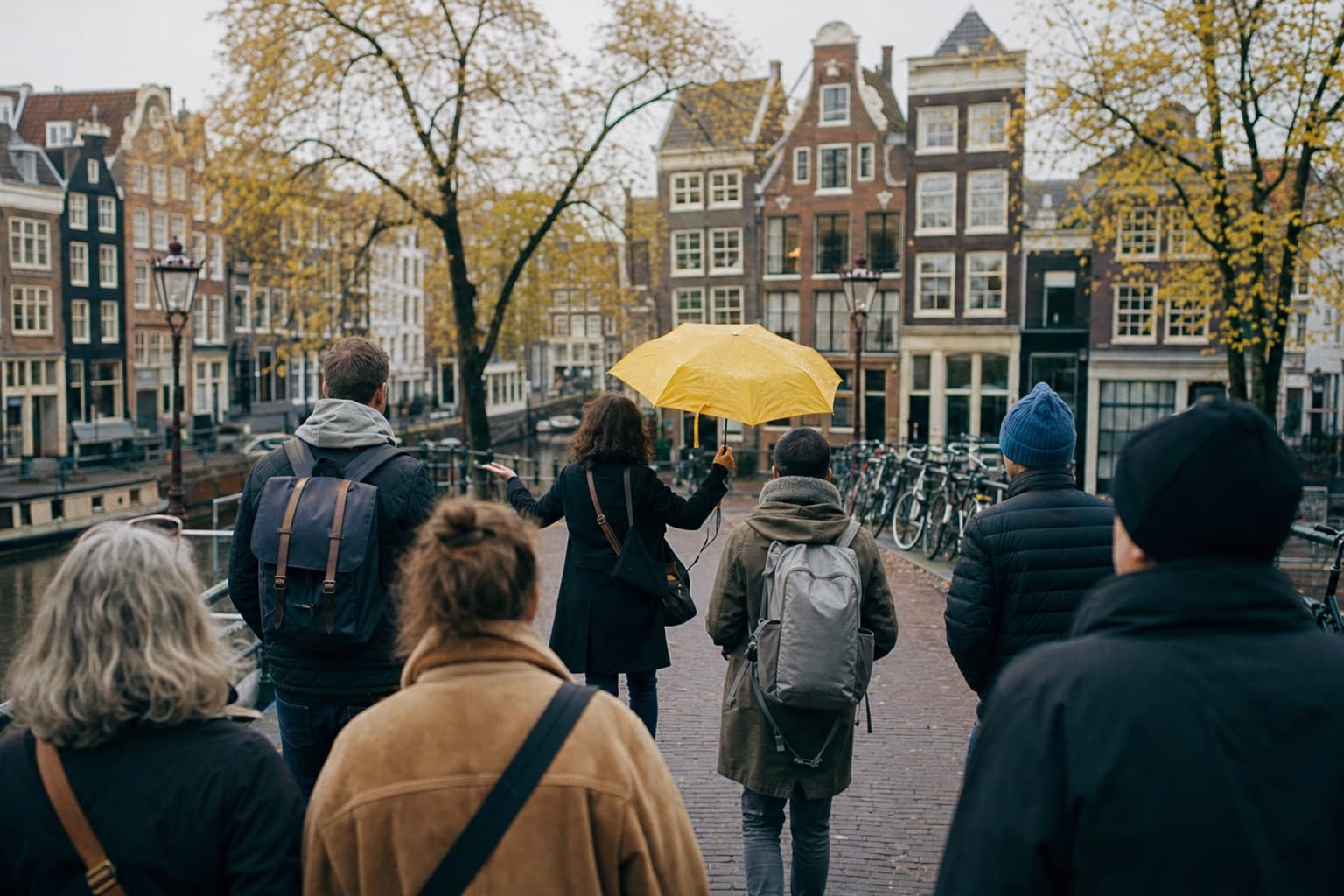
From there you move on to the canal ring, the Grachtengordel. The set of 17th-century canals inside the Singelgracht has been a UNESCO World Heritage Site since 2010. The rings of water were laid out to expand a city growing on trade, and the guide teaches you to read the narrow facades, the hoisting beams on the gables and the reason for the leaning houses.
The Jordaan and the Westerkerk
The Jordaan began as a district of craftsmen and workers, on the far side of the stately canals. Today it is a maze of small streets, galleries, cafés and courtyards, and the guide uses it to explain who lived where in a city that kept the rich well apart from the workers. It is the part of the walk where it pays to slow down.
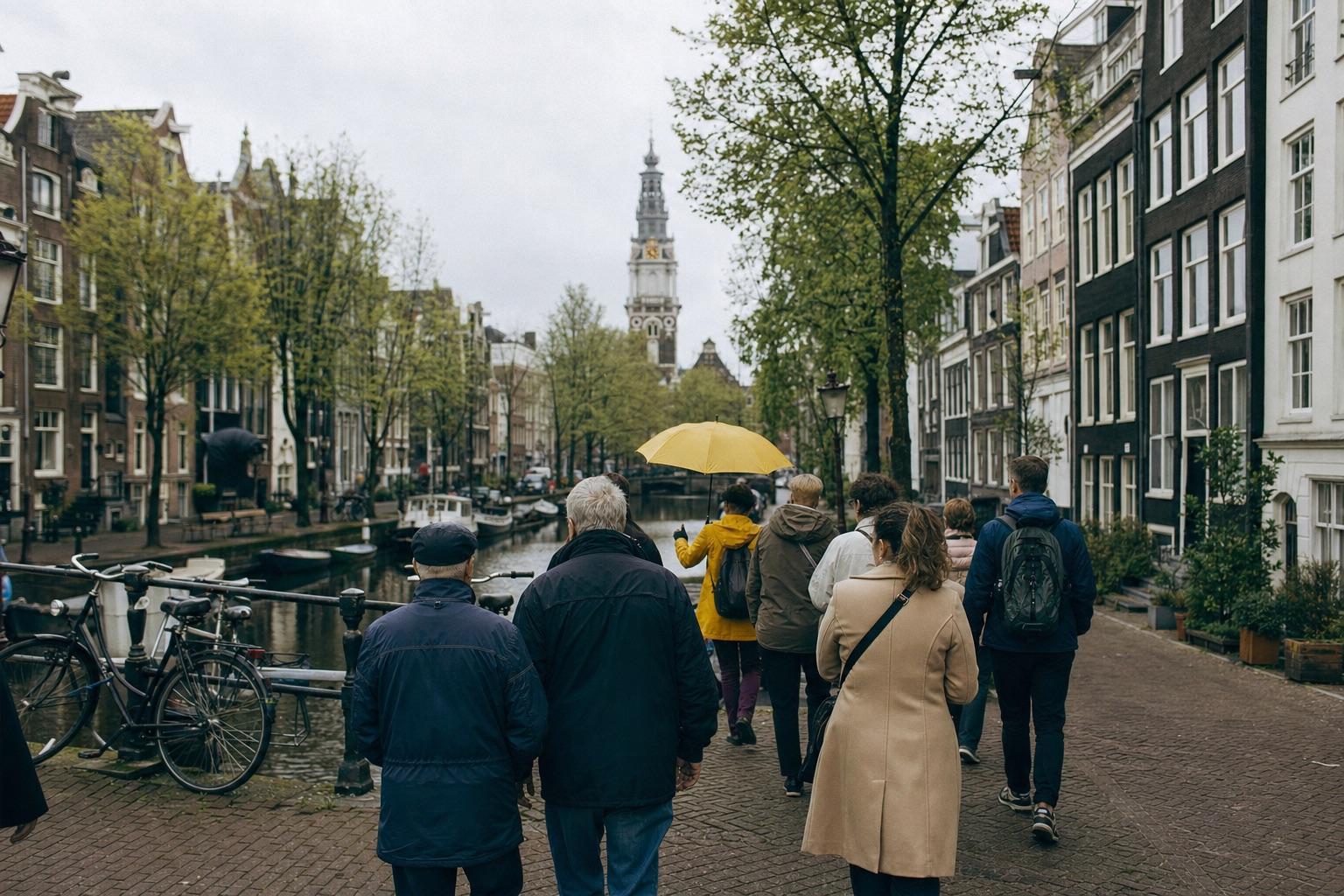
The route ends near the Westerkerk, whose tower is one of the landmarks of the old skyline and can be seen from many points in the centre. Anne Frank mentioned its bells in her diary. It stands a few steps from the house where she hid, which is why it is the natural end of the route.
The Anne Frank House on the Prinsengracht: from outside and with a ticket
The free tour stops in front of the Anne Frank House on the Prinsengracht, and the guide tells the story of the family, the hiding place and the Nazi occupation. But the free tour does not go inside: it is a walk on the street, and the museum is visited with its own ticket, which is not included.
According to the museum's official website, tickets are sold only online and for a specific time slot, with no sales at the door. Every Tuesday at 10:00 (Amsterdam time) the tickets for a date six weeks later go on sale. Each ticket is valid only for that date and time, and cannot be exchanged or refunded. Since slots sell out, the practical move is to book before you travel and check the official website in case the timings change.
Which free tours there are and how to choose
There are several options in Spanish. One focuses on the Red Light District: the history, legislation and present of prostitution in the city. Another is the historic centre tour, which goes through the city from its fishing origins to its rise as a trading power. A third walks the heart of Amsterdam with a mix of history and current life. And there is a broader historical route covering the Golden Age, Anne Frank and the Second World War.
If you have only one morning or afternoon, the historic centre tour gives you the full map. If you care about the memory of the 20th century, choose the one that includes Anne Frank and the war. And if you want to understand the Red Light District calmly, choose the one dedicated to De Wallen. The advantage of doing it in Spanish is being able to ask without effort, especially on delicate topics such as legislation. At the end, the usual benchmark is 15 to 20 euros per person.
Frequently asked questions
- Can a free tour walk past the windows in the Red Light District?
- No. Since 2020 the city council has banned guided tours in front of the windows. The guide tells the district's history from streets and squares that do not pass them. If you want to see the district on your own, do so with respect.
- Can you take photos in the Red Light District?
- Buildings and streets, discreetly, yes. The workers and windows with people in them, no: they are not photographed or filmed, not even from a distance. The guide will ask for this at the start and it is a basic rule of respect.
- Does the free tour go inside the Anne Frank House?
- No. It leaves you in front of the house and the guide tells its story, but the ticket is bought separately. It is sold only online, with a time slot, and sells out weeks in advance.
- How long does the historic centre free tour last?
- It usually runs around two hours, though it varies with the route and the guide. The exact duration, along with the meeting point, comes in the booking confirmation.
- Are there Spanish-language Red Light District and Anne Frank free tours?
- Yes. There are Spanish-language routes dedicated to the Red Light District, the historic centre, the heart of the city and the history with Anne Frank and the Second World War. They are booked online and the guide confirms the meeting point.