In this article (8 sections)
It is a Trip Tours tour of our own, with local guides from the Barkeno Tours team in Barcelona. The tour page has the times and the booking; here you get the background so you arrive knowing what to look at.
Why Gaudí needed the Eixample
To understand Gaudí you have to understand the district where he worked. In the late 19th century Barcelona pulled down its walls and grew over a grid designed by Ildefons Cerdà: wide streets, blocks with cut-off corners and plenty of plots to fill. The Catalan bourgeoisie, enriched by industry, wanted houses that said something about who paid for them, and Catalan Modernisme was born.
Antoni Gaudí (1852-1926) was the architect who took that freedom furthest: organic forms, stone that looks soft, wrought iron that seems vegetal. Several of his works are on UNESCO's World Heritage List: the original listing dates from 1984, with Casa Milà, Palau Güell and Park Güell, and in 2005 it was extended to include, among others, Casa Batlló and the crypt and the Nativity façade of the Sagrada Família.
The tour uses that logic as its thread: it is not a list of buildings but a way of learning to read a Modernista façade, with its symbols, its materials and its rivalries.
Do it with a guide
Barcelona's Old Town Free Tour
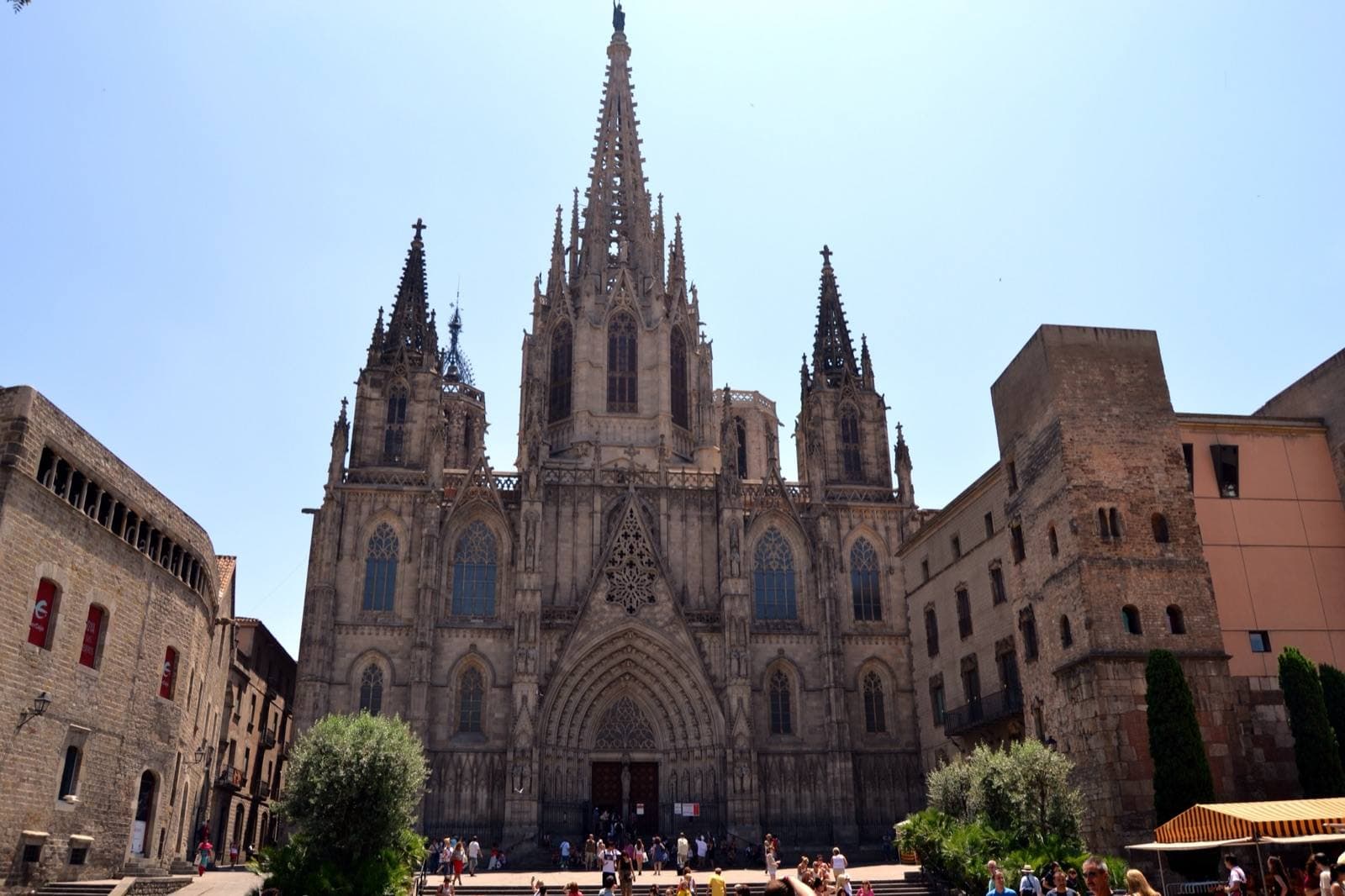
Barcelona's medieval and Roman heart: the Cathedral, Plaça Sant Jaume, the remains of Barcino and the Call, the old Jewish quarter hidden among the alleys.
Passeig de Gràcia and the Manzana de la Discordia
Passeig de Gràcia is the avenue where the bourgeoisie put its shop window. Today it shares space with luxury shops, but it keeps details you miss if you only look at your phone: the Modernista street lamps by Pere Falqués, the hydraulic tile floors and the tops of the buildings, almost always more interesting than the ground floors.
A short stretch holds the so-called Manzana de la Discordia, where several architects built very different houses wall to wall. The name plays on the clash of styles: each owner wanted their façade to be the one that caught the eye. Next to Casa Batlló stands Casa Amatller, by Josep Puig i Cadafalch for the chocolatier Antoni Amatller, with a stepped, Flemish-looking gable that deliberately contrasts with Gaudí's house.
What to look at here: raise your eyes above the shop windows, compare how each building handles its top, and notice how much the scale of the windows changes from one house to the next.
Casa Batlló: the house of bones
Casa Batlló, at number 43 Passeig de Gràcia, was not built from scratch. It was a house from 1877 that the textile industrialist Josep Batlló wanted to renovate, and Gaudí remodelled it between 1904 and 1906, redoing the façade, enlarging the light well and crowning it with a new roof. That explains something many people miss: the structure is older, and what you see is a reinvention.
It is called the house of bones for its skull-shaped balconies and the columns that recall shinbones. The roof mimics the back of a dragon, and the façade shimmers with fragments of ceramic and glass that change colour with the light. Many read this as a nod to the legend of Saint George, patron saint of Catalonia, although Gaudí left no written explanation, so treat it as an interpretation.
What to look at: the near-total absence of straight lines, the contrast between the stone lower part and the ceramic upper part, and how the neighbouring Casa Amatller seems to come from another planet.
Book free, leave a contribution at the end
La Pedrera (Casa Milà): the stone quarry
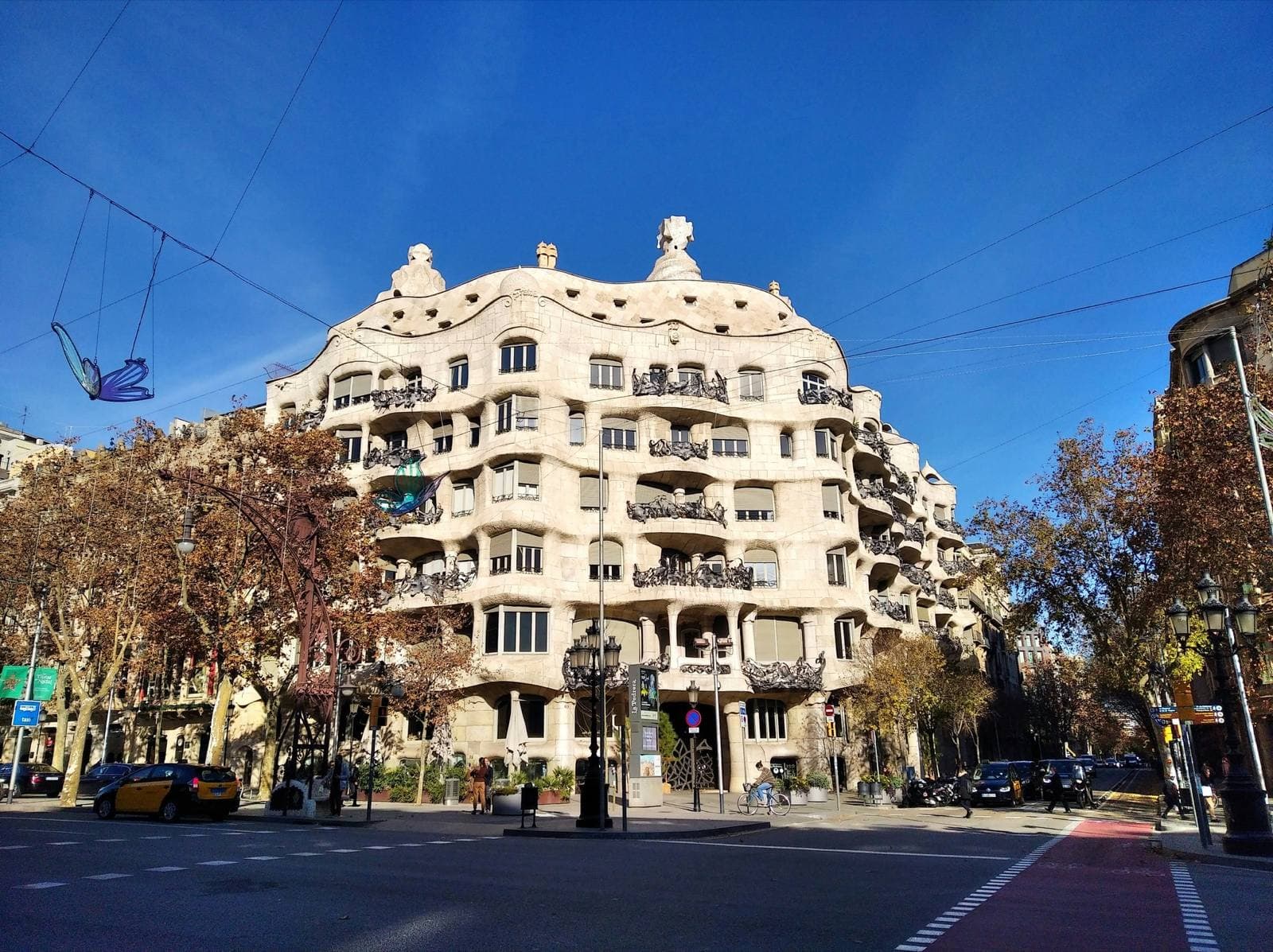
La Pedrera is the commission that Pere Milà and his wife, Roser Segimon, gave Gaudí in 1906. It was built between 1906 and 1912, planned as the family home on the main floor with the other flats rented out. Its nickname, the quarry, was given by people at the time, and it was not a compliment: the rippling stone façade, without a single straight line, baffled more than one neighbour.
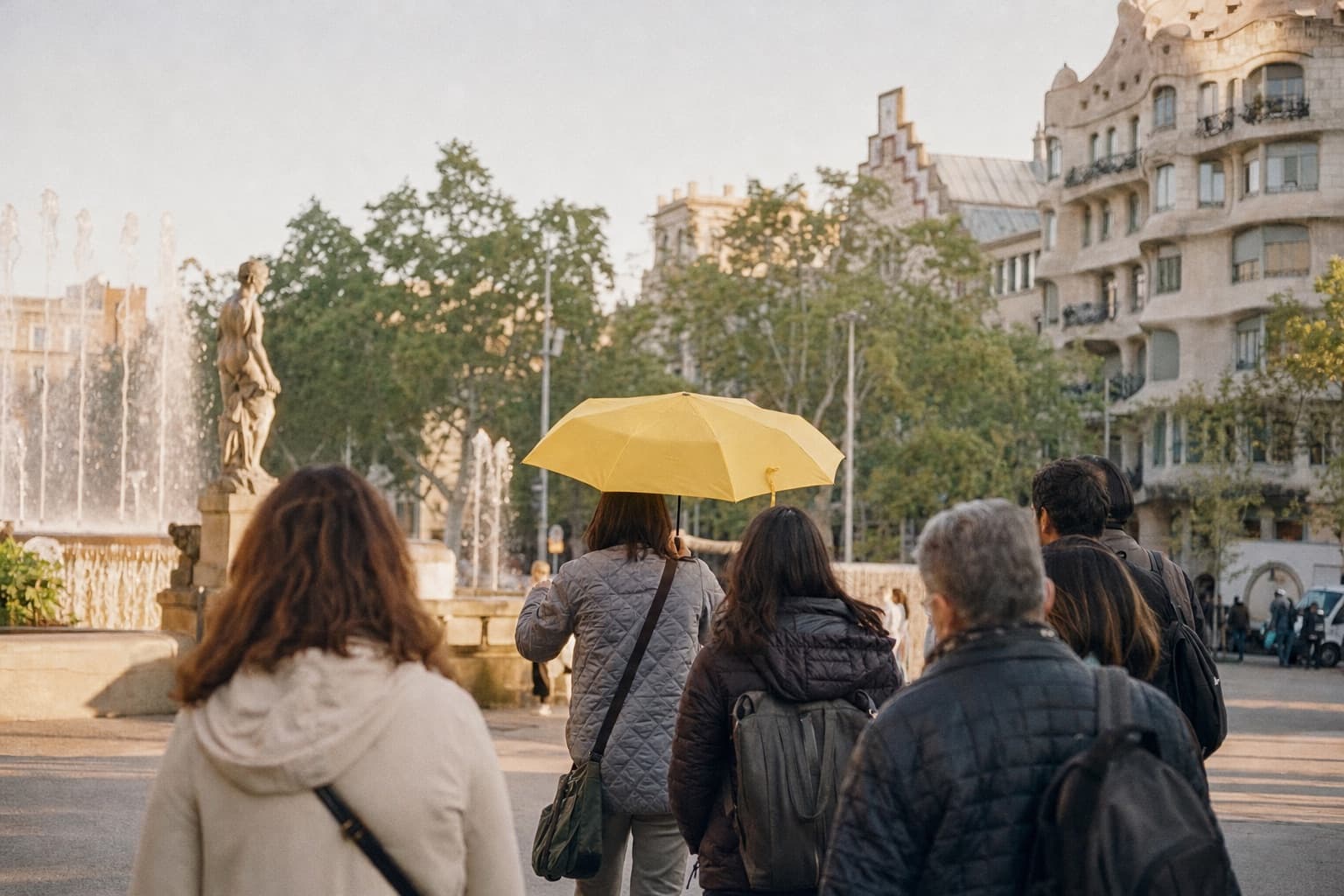
Today it is one of the Gaudí works in the original 1984 UNESCO listing. What surprises most from the street are the wrought-iron balconies, which look like tangled seaweed, and the feeling that the stone moves like a wave.
What to look at: follow the line of the balconies with your eyes, see how the façade curves at the corner and, if the angle allows, look for the rooftop chimneys, which look like helmeted warriors. Seeing them up close means going inside, and that is outside the tour.
The Sagrada Família from the outside
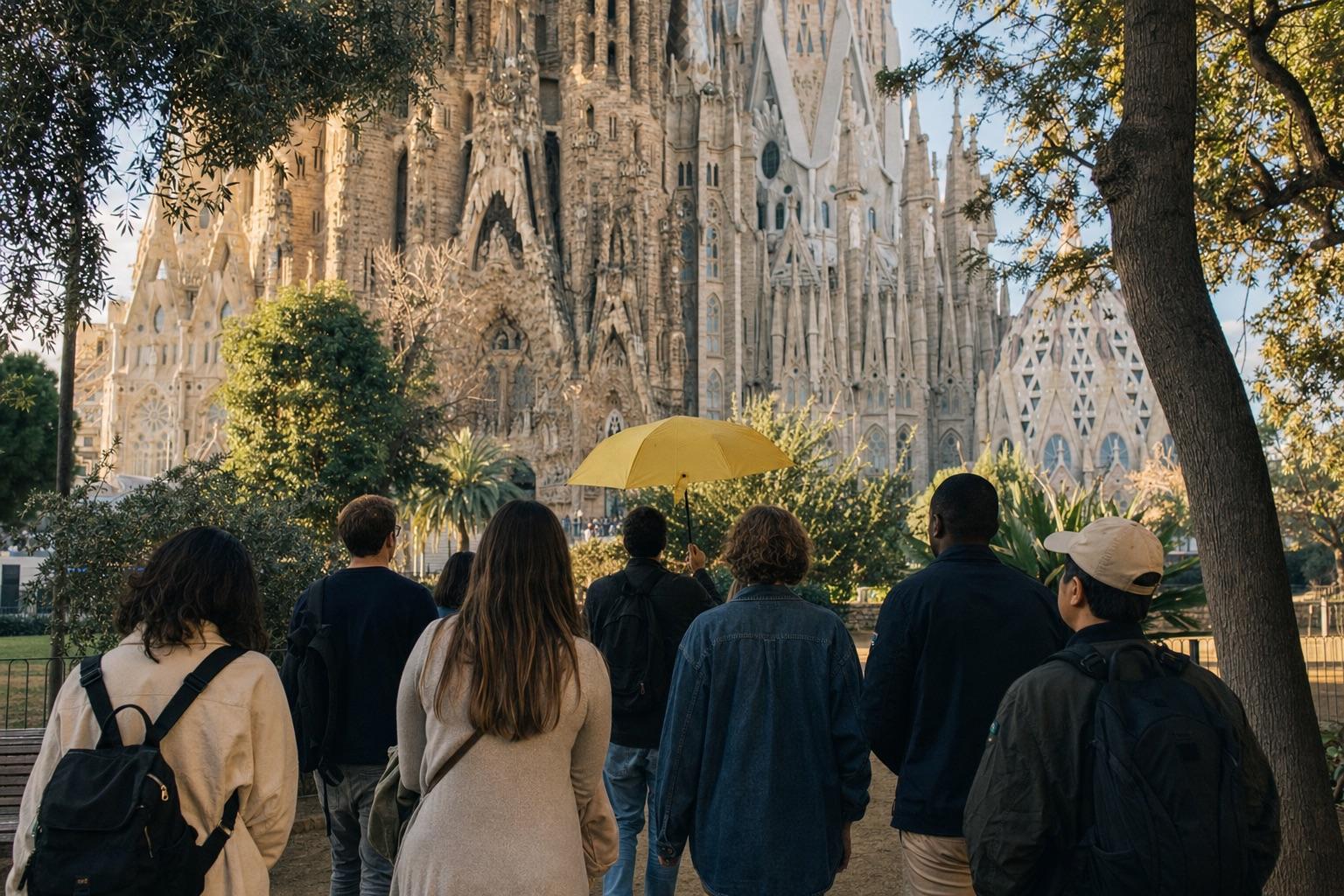
The Sagrada Família began in 1882 with a Neo-Gothic project by the architect Francisco de Paula del Villar. In 1883 Gaudí took over the direction and changed course completely: he gave a large part of his life to the work and died in 1926 with the temple far from finished. In 2010 Pope Benedict XVI consecrated the temple and declared it a minor basilica, and construction continues. If you want to know what stage the towers are at and when each milestone is expected, check the basilica's official website, because it changes over the years and we will not give you a date that goes out of date.
From outside, the best approach is to read the façades like a stone book. The Nativity façade, the one Gaudí saw well advanced and part of the World Heritage listing since 2005, is full of scenes, plants and animals. The Passion façade, on the other side, is drier and more angular, on purpose: it speaks of suffering and does not want to please.
The tour closes here, looking at the temple from the street, with the context of everything you have seen before: when you reach the Sagrada Família, you know it is the culmination of the same search for natural forms.
What is included, what is not and how to book
The free tour includes a professional local guide, the explanation of each building and a small group. It does not include tickets to monuments, museums or interiors, nor food, nor transport to the meeting point. The contribution to the guide is not included either: you decide it at the end, and the usual benchmark is 15 to 20 euros per person.
Booking is free and is done from the tour page on this site: you choose the day, the time and the language, say how many people are coming and pay nothing in advance. If you cannot come, you can cancel at no cost until shortly before the start time.
Tips: metro, shoes and the Sagrada Família ticket
The Eixample is flat with wide streets, so you do not need technical footwear, but you do need comfortable shoes: it is two and a half hours on your feet, with long stops in front of each façade. Bring water and sun protection in summer, and a light layer in winter, because the wind runs through the corners of the Eixample.
The tour includes a metro ride with the group towards the Sagrada Família. Have your ticket or card ready, because buying one at the machine while the group waits slows everyone down.
If you want to go inside the Sagrada Família, the ticket is separate and is bought in advance on its official website, because it tends to sell out and works with time slots. Book a slot with a margin after the tour, not right at the end, in case the group runs long or you want to eat something. The same goes for Casa Batlló and La Pedrera if you want to see them inside: their times and prices are on their official websites and they change, so check them before deciding.
Frequently asked questions
- Does the free tour go inside the Sagrada Família?
- No. You see the basilica and the other buildings from the outside, with the guide's explanation. If you want to go in, buy the ticket separately and in advance on the Sagrada Família's official website.
- How long is the tour and is there a lot of walking?
- It lasts about two and a half hours. The Eixample is flat with wide streets, and the pace is relaxed, with stops to explain each building.
- Is the Gaudí free tour in English and in Spanish?
- Yes. The tour runs in Spanish and in English, and you choose the language when you book.
- How much do you leave the guide at the end?
- Booking is free and you pay nothing in advance. At the end, the usual benchmark is 15 to 20 euros per person, depending on how much you enjoyed the walk.
- Can I cancel my booking?
- Yes, at no cost until shortly before the start time. Since you pay nothing in advance, cancelling costs nothing.
- Is it better to do the tour before or after visiting the Sagrada Família inside?
- Before usually works better: you reach the interior with the context of Gaudí and Modernisme. Leave a margin between the end of the tour and your entry time slot.