In this article (8 sections)
Trip Tours is a walking-tour operator based in Madrid; in Berlin we work with trusted affiliated guides, so what follows mixes documented history with what a guide tells you on the ground.
The Wall in five minutes: from 1961 to 1989
The Wall went up on the night of 12 to 13 August 1961, suddenly and without warning. The GDR sealed the border with West Berlin with barbed wire and soldiers, and within weeks the wire became concrete. What started as a barrier grew into a border system of around 155 kilometres that completely encircled West Berlin, about 43 of them running through the city itself and cutting streets, squares and even cemeteries in two.
What we call the Wall was in fact two walls. Between the outer one, the wall from the photos that faced West, and the inner one facing East lay the death strip: a cleared band of sand, floodlights, watchtowers, barbed wire and patrols with orders to shoot. According to the Gedenkstätte Berliner Mauer, the Berlin Wall Memorial, more than 140 people died trying to cross it.
It fell on 9 November 1989. That night thousands of East Berliners turned up at the border crossings. The first to open was Bornholmer Strasse, on the Bösebrücke bridge, and before midnight everyone was crossing. In the months that followed the city took almost all of it down.

Do it with a guide
Sachsenhausen Concentration Camp Memorial
Sachsenhausen Concentration Camp. A must-see visit. In this institution of terror, which took the lives of more than 60,000...
What remains today and why almost everything disappeared
If the Wall was 155 kilometres long, how come you barely see it? The answer lies in 1990. For Berliners it was not a monument but a wound, and as soon as it fell the priority was to get it out of the way: reopen streets, stitch neighbourhoods back together, erase the strip. Segments were knocked down, crushed or sold. What survived did so more through neglect or through protests by residents and artists than by design.
So today the Wall is visible in three big places and many small details. The big ones are the East Side Gallery, the memorial on Bernauer Strasse and the two hundred metres at the Topographie des Terrors. The small ones are all over the city: the double row of cobblestones marking in the ground where it ran, loose segments at Potsdamer Platz, plaques, and the Mauerweg, a signposted trail of around 160 kilometres that follows the whole course and can be walked or cycled in stages.
East Side Gallery: the longest stretch still standing
This is the image everyone has in mind: 1.3 kilometres of Wall along the river Spree, in Friedrichshain, the longest stretch still standing. In 1990, with the Wall barely down, artists from all over the world painted the side facing the street, the one that had looked East and that nobody had been allowed to touch; that is where you find the kiss between Brezhnev and Honecker, the Trabant bursting through the concrete and dozens more murals. It is always open and free: it is a street.
Take the S-Bahn to Warschauer Strasse or Ostbahnhof; the Wall runs between the two stations and ends by the Oberbaumbrücke, the red-brick bridge over to Kreuzberg. Worth knowing: it is the most photographed part and the least explanatory. Here you see the Wall as a canvas, not as a border, because the death strip lay on the other side, towards the river. That is why you should combine it with Bernauer Strasse, which tells what this one cannot.
Book free, leave a contribution at the end

Bernauer Strasse: the memorial that truly explains it
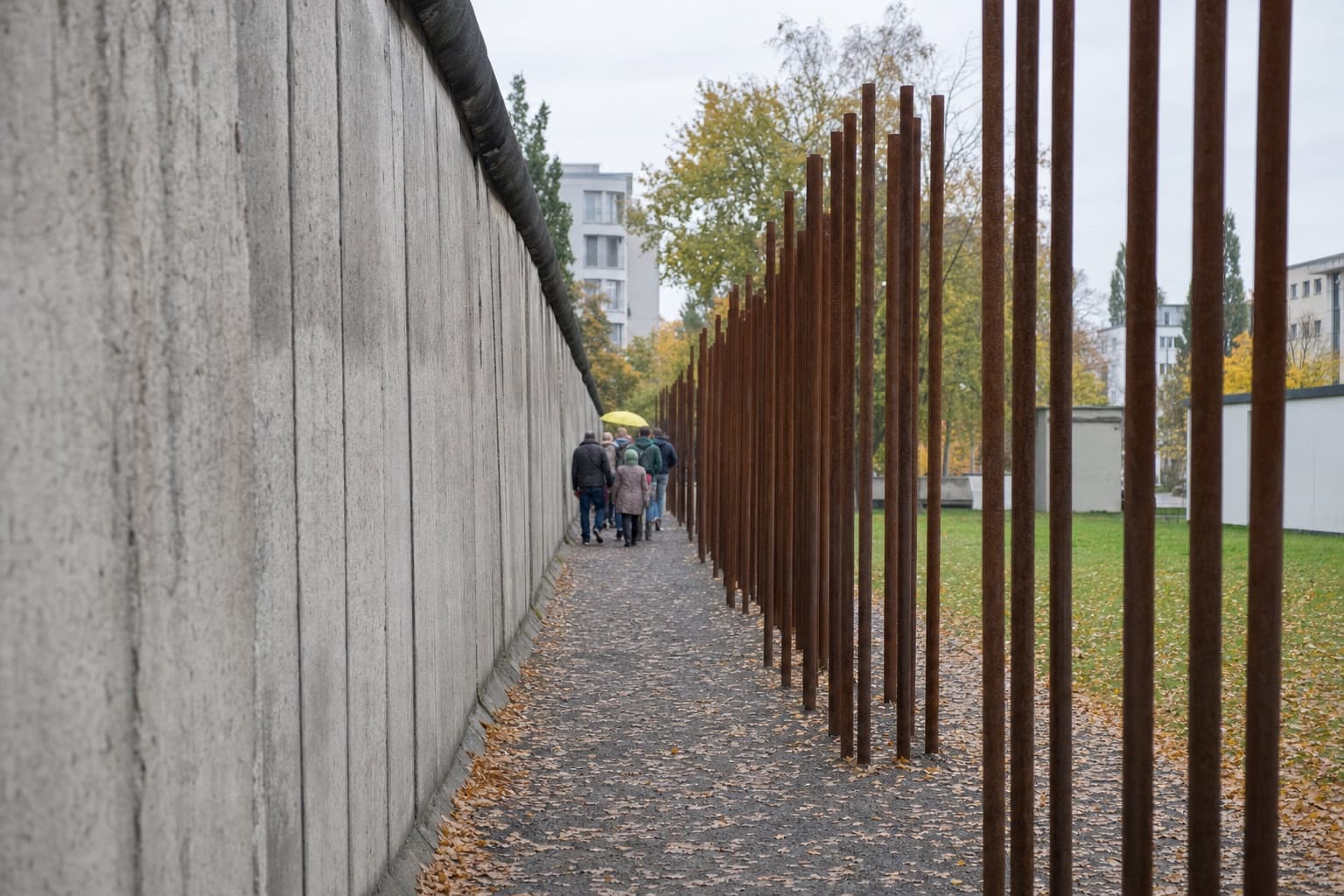
If you can only visit one place, make it this one. The Gedenkstätte Berliner Mauer, the official Berlin Wall Memorial, occupies a long stretch of Bernauer Strasse, a street the border split in two: the houses stood in the East and the pavement in the West, and this is where the photos of people jumping from windows in August 1961 were taken. Today it preserves a piece of the complete system, with outer wall, death strip and watchtower, just as it was.
The documentation centre is free and has a viewing platform from which you see the whole strip from above, the only way to grasp the scale. Along the street there are panels, photographs, the remains of the Church of Reconciliation that the GDR blew up, and the memory of the tunnels dug underneath. Take the U-Bahn to Bernauer Strasse or the S-Bahn to Nordbahnhof. Allow at least an hour, more if you go into the exhibition, and give yourself time to read: this is a place of remembrance, not a backdrop.
Checkpoint Charlie, Topographie des Terrors and Potsdamer Platz: the free tour's backbone
These three sites sit close together in the centre and form the heart of the Wall and Cold War free tour. Checkpoint Charlie was the crossing between the American and Soviet sectors, the one from the spy films. Today there is a replica of the guard hut in the middle of the traffic, with plenty of tourism around it: it deserves a short stop for the photo and for the context your guide gives, not a whole morning.
A few minutes' walk away, on Niederkirchnerstrasse, the Topographie des Terrors brings two histories together on one plot: around 200 metres of original Wall, unpainted and with the concrete chipped away by souvenir hunters in 1989, and the open-air exhibition on the Gestapo and the SS, whose headquarters stood right here. It is free. Carrying on to Potsdamer Platz, no man's land for almost thirty years and now a forest of skyscrapers, you find loose segments and the double row of cobblestones crossing the roadway. Seeing all three in one walk is what turns the Wall from an object into a map.
A one-day walking route and the Wall and Cold War free tour
To see it all on your own, this is the order that wastes the fewest trains. Start in the morning on Bernauer Strasse (S Nordbahnhof). Take the S-Bahn down to the centre and walk the Potsdamer Platz, Topographie des Terrors and Checkpoint Charlie axis at an easy pace. Have lunch around Kreuzberg and finish the afternoon at the East Side Gallery (S Warschauer Strasse), with the low light over the Spree. That is four or five hours of walking and three S-Bahn hops.
The other option, and the one we recommend for your first day, is the Wall and Cold War free tour: a guided group walk through Checkpoint Charlie, the Topographie des Terrors, Potsdamer Platz and the Wall remnants in the centre, telling the story of the GDR, life on both sides and the night of 9 November along the way. It lasts around two to two and a half hours. You book online and booking costs nothing; at the end each person leaves a voluntary contribution for the guide, and the usual benchmark is 15 to 20 euros per person. There are departures in English and in Spanish; Berlin free tours usually set off from the Brandenburg Gate or Alexanderplatz, and the exact spot comes in your confirmation email. If you have time to spare, the Essential Berlin tour and the Alternative Berlin walk through Kreuzberg and Friedrichshain round off the city, and for the Sachsenhausen camp there is a paid day trip from Berlin.
9 November and tips for your visit
Every 9 November Berlin remembers the fall of the Wall, and 2026 marks 37 years. The events change every year: concerts, light installations, exhibitions and a ceremony on Bernauer Strasse with candles along the strip. If your trip falls on those dates, check the city's official programme a few days ahead, because the memorials fill up and some free tours adjust their route. It is also the time of year when Berlin starts getting properly cold: coat, gloves and comfortable shoes, because everything described here is outdoors.
A few simple rules. On Bernauer Strasse and at the Topographie des Terrors you are in places of remembrance: keep your voice down and do not climb on anything. At the East Side Gallery do not touch or write on the murals; every tourist signature has forced another restoration. And one tip every guide gives: look down. The double row of cobblestones crosses the entire centre and is the most honest way to see the Wall, because it marks the exact line where a city was split for twenty-eight years.
Frequently asked questions
- Is any of the Berlin Wall still standing?
- Yes, though far less than people expect. Of the original 155 kilometres, three big stretches remain (the East Side Gallery, the Bernauer Strasse memorial and around 200 metres at the Topographie des Terrors) plus small remnants around the centre, such as loose segments at Potsdamer Platz and the double row of cobblestones marking the course. The rest was dismantled in 1990.
- Where is the longest stretch of the Wall?
- At the East Side Gallery in Friedrichshain: 1.3 kilometres of Wall along the river Spree, painted in 1990 by artists from all over the world. Take the S-Bahn to Warschauer Strasse or Ostbahnhof; it is open at any hour, because it is a street.
- Is it free to see the Berlin Wall?
- Yes. The East Side Gallery is an open street, the Topographie des Terrors is free, and so is the Bernauer Strasse memorial, including its documentation centre and viewing platform. You only pay for public transport to move between them.
- How long is the Wall free tour and how much do you leave?
- Around two to two and a half hours on foot through the centre, covering Checkpoint Charlie, the Topographie des Terrors, Potsdamer Platz and the Wall remnants. Booking costs nothing; at the end each person leaves a voluntary contribution for the guide, and the usual benchmark is 15 to 20 euros per person.
- Are there Berlin Wall free tours in English?
- Yes, and English is the language with the most departures in Berlin, alongside Spanish. There is a Wall and Cold War free tour as well as Essential Berlin and Alternative Berlin walks. In Berlin we work with trusted affiliated guides; departures usually start at the Brandenburg Gate or Alexanderplatz and the exact spot comes when you book. Outside summer there are fewer slots, so book ahead.
- Is Checkpoint Charlie worth it?
- As a short stop, yes; as a destination, no. The hut is a replica surrounded by traffic and souvenir shops, but the site is historic and makes sense with a guide to explain it. What really teaches you something is a few minutes away: the 200 metres of original Wall at the Topographie des Terrors and Bernauer Strasse.