In this article (7 sections)
Lutetia beneath your feet: why it is called the Latin Quarter
The Latin Quarter is not named so out of any romantic whim. The name comes from Latin, the language taught at the Sorbonne from the thirteenth century and in which students arriving from all over Europe understood one another on the slopes of the mountain of Sainte-Geneviève. But beneath the faculties there is something far older. Here stood Lutetia, the Roman city, and you can still see it: the Arènes de Lutèce, a first-century amphitheater that appears out of nowhere between the rue Monge and the rue de Navarre, and the baths of the Musée de Cluny, on the boulevard Saint-Michel, with its stone walls still standing after eighteen centuries.
If you go up the rue Saint-Jacques you are treading the old Roman road that left Lutetia toward the south and that pilgrims later took on the way to Santiago. It is one of those streets whose layout has not changed in two thousand years, however many bookshops, crêperies and lecture halls have been piled on top.

Do it with a guide
The Original Free Tour of Paris
From medieval kings to revolutionaries and emperors, Paris is a city shaped by centuries of drama, beauty and bold ideas, that...
The Sorbonne and the Panthéon: philosophers and a dome that turns
The Sorbonne was founded by Robert de Sorbon in 1257, and the Place de la Sorbonne is still a good place to watch the students come out almost eight hundred years later. A few meters away is the Panthéon, which began as a church dedicated to Sainte-Geneviève and ended up as the mausoleum of the Republic, where the country buries its great names. Marie Curie was the first woman brought there on her own merits, in 1995. But what really stops people beneath the dome is Foucault's pendulum: in 1851, hung from that very point, it demonstrated before everyone's eyes that the Earth turns, with no proof other than seeing it drift on its own over the course of the day.
Around it, the neighborhood keeps its oldest memory in lesser stone, the kind that does not make the covers. Near the Seine, half hidden among medieval alleys, Saint-Séverin and Saint-Julien-le-Pauvre hold on, two of the oldest churches in Paris, built when these streets were of tonsured students and not of tourists. They are the kind of corner you walk right past if no one tells you to look.
Sainte-Geneviève, the young woman who stood up to Attila
In the year 451 Attila and his Huns were advancing on Paris and panic spread among its inhabitants, who were already packing their bags to flee. A young consecrated woman who had come from Nanterre, Geneviève, convinced them to stay and pray. The Huns changed course and Paris was saved. Ever since, Sainte-Geneviève is the patron of the city, and her relics are venerated in the church of Saint-Étienne-du-Mont, right behind the Panthéon, which also keeps the only jubé, the carved stone gallery that crosses the nave, still standing in all of Paris.
It is the kind of tale that changes depending on where you hear it. In front of the facade of Saint-Étienne-du-Mont, with someone pointing at the reliquary, the legend stops being a date and becomes a neighborhood. That is why a free tour of the Latin Quarter is usually the most comfortable way to fit history, stone and street together without jumping from one plaque to another.
Book free, leave a contribution at the end

Montmartre, the mount of the martyrs
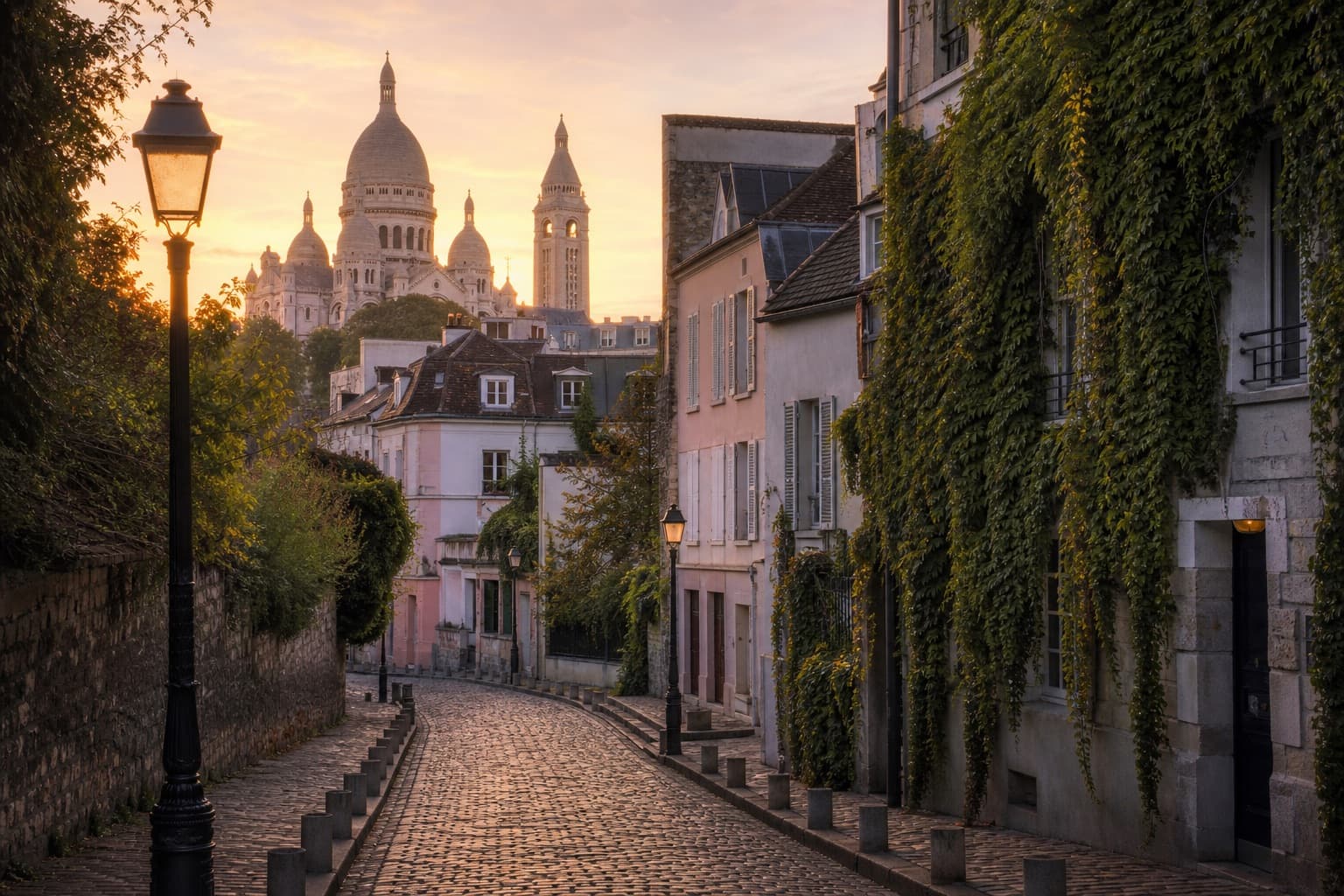
Montmartre most likely means the mount of the martyrs. The martyr is Saint Denis, first bishop of Paris, beheaded by the Romans at the top of the hill around the year 250. Medieval legend tells that Denis stooped down, picked up his own head and set off walking north preaching, until he fell several kilometers later, on the spot where the basilica of Saint-Denis stands today. On the hill itself survives Saint-Pierre de Montmartre, one of the oldest churches in Paris, from the twelfth century.
Above it all shines the Sacré-Cœur, much younger than it looks: it was begun after the war of 1870 and not finished until 1914. It is made of a Château-Landon stone that releases calcite with the rain, so it stays white without anyone cleaning it, a stonemason's trick that explains its almost unreal color century after century.
Bohemians, windmills and the man who walked through walls
In the late nineteenth and early twentieth centuries, Montmartre was the workshop of Europe. In the Bateau-Lavoir, a ramshackle building on the Place Émile-Goudeau, Picasso painted Les Demoiselles d'Avignon; Modigliani and Juan Gris passed through as well. Van Gogh lived with his brother Theo at number 54 of the rue Lepic. Around the corner the cabaret Au Lapin Agile holds on, where wine was once paid for with paintings, and down the slope, on the boulevard de Clichy, the Moulin Rouge has been turning since 1889, the windmill that Toulouse-Lautrec immortalized.
The hill keeps corners that seem invented and are not. In the Place Marcel-Aymé, a statue shows a man coming out of a wall: it is the Passe-Muraille, the character by Marcel Aymé able to walk through walls who one day got stuck in one. A few streets away, in the Place des Abbesses, is the mur des je t'aime, a wall with I love you written in more than two hundred languages, and one of only two Métro entrances that keeps the original Art Nouveau canopy by Hector Guimard. There is even a working vineyard, the Clos Montmartre, harvested every October.
How to join the two hills in a single day
The Latin Quarter and Montmartre are on different banks and in different moods: one on the left bank, studious and Roman; the other on the heights of the right bank, artistic and neighborly. Splitting them by half a day works well. In the morning, Lutetia, the Sorbonne and the Panthéon; in the afternoon, the climb to Montmartre, better early if you want the upper lanes before the tide of people. Line 12 of the Métro drops you at Abbesses, the deepest station in Paris, with its lift and its painted staircase.
If it is your first time, starting with a free tour of Paris saves you the map and gives you the thread that joins legions, saints and bohemians. The spot is held with nothing paid up front and, at the end, each participant gives the guide between 15 and 20 euros per person depending on how much the walk gave them. With that sorted, the two hills almost walk themselves and each street begins to tell you its own story.
Frequently asked questions
- Can you see the Latin Quarter and Montmartre in a single day?
- Yes, if you choose the main sights of each. A morning is enough for the Panthéon, the Sorbonne, Saint-Étienne-du-Mont and the Arènes de Lutèce, and an afternoon for Montmartre, with its church of Saint-Pierre and the bohemian corners. They are at opposite ends of the city, so it is best not to linger too long at each stop.
- How do you get from the Latin Quarter to Montmartre by Métro?
- The easiest is Line 4 from Saint-Michel or Odéon to Marcadet-Poissonniers and there change to Line 12 up to Abbesses, in the heart of Montmartre. If you would rather arrive in front of the Sacré-Cœur, get off at Anvers, on Line 2. Between one area and the other it is a good half hour on the Métro.
- Is the legend of Saint Denis walking with his head real?
- It is a medieval legend, not a proven fact. What does seem historical is that Denis was a bishop martyred in Montmartre around the year 250. The image of the saint carrying his own head, called a cephalophore, also explains two names on the map: Montmartre, the mount of the martyrs, and the basilica of Saint-Denis, where according to the tale he arrived on foot.
- What is the story behind the name of the Latin Quarter?
- It has nothing to do with Spain or Latin America, but with the Latin spoken in its lecture halls from the Middle Ages. Beneath those faculties lies buried Lutetia, the Roman city, and you can still see its amphitheater, the Arènes de Lutèce, and the baths of the Musée de Cluny. The rue Saint-Jacques follows the layout of the old Roman road that led south.