In this article (7 sections)
The Colosseum and the Forum: what the stones do not tell
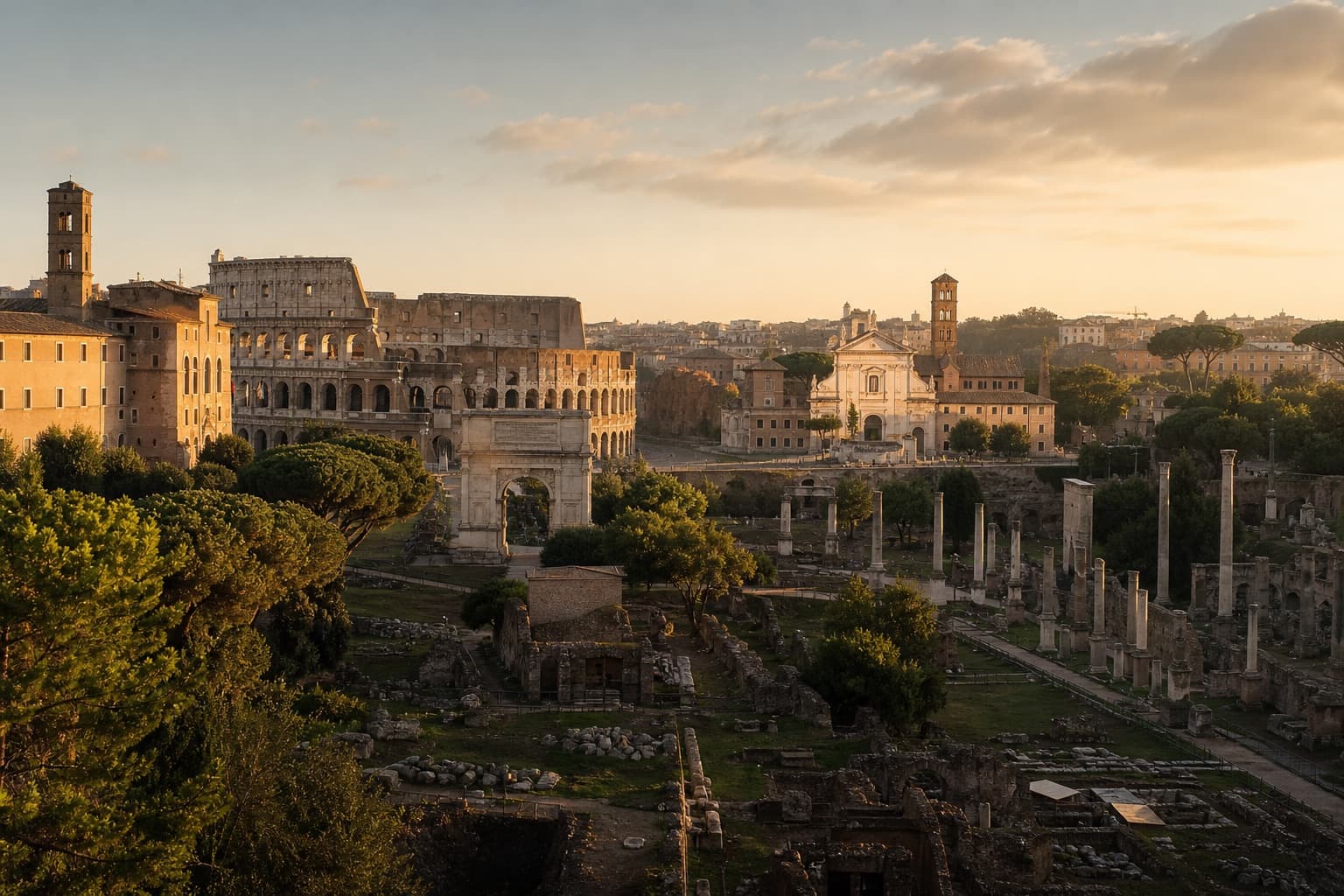
The Colosseum, whose real name is the Flavian Amphitheater, was inaugurated in AD 80 with a hundred straight days of games. It held some 50,000 spectators, who entered with a numbered ceramic token according to their social rank, something like today's ticket with an assigned seat. And its nickname does not come from its size: next to it rose the Colossus of Nero, a bronze statue over thirty meters tall that ended up giving its name to the whole building. Beneath the arena you can still see the hypogeum, the network of tunnels and lifts where gladiators and wild beasts waited before coming out on stage.
A few meters away begins the Roman Forum, the esplanade where the politics of the Republic beat. Along the Via Sacra the generals paraded in their triumphs, passing under the Arch of Titus, which still shows in relief the sacking of the temple of Jerusalem in AD 70. Right above it rises the Palatine Hill, where Augustus and his successors lived in residences so lavish that from there comes, literally, the word palace. It is easy to walk right past without understanding what each stone was, and that is why many people begin their trip with a free tour of central Rome: a local guide puts a name and a date to ruins that, on their own, tell almost nothing.

Do it with a guide
Bohemian Neighbourhood Tour: Trastevere
On this free tour we want to share with you one of the most beautiful corners of the Eternal City; the emblematic neighbourhood of Trastevere....
The she-wolf, Romulus and Remus: the founding legend
The version Rome tells of itself begins with two babies abandoned in a basket on the Tiber. According to the myth, a she-wolf took them in and suckled them in the cave of the Lupercal, at the foot of the Palatine, until a shepherd raised them. One of them, Romulus, traced the sacred boundary of the city with a plough on 21 April 753 BC, the date the Romans always took as their birthday. When his brother Remus crossed that line to mock him, Romulus killed him. The city was born, from the very start, marked by a fratricide.
The Capitoline she-wolf, the bronze statue that sums up that story, is kept today in the Capitoline Museums, on the hill that Michelangelo reordered centuries later. And the cave is not just literature: in 2007 a team of archaeologists located beneath the Palatine a cavity decorated with mosaics that many identified with that Lupercal. Real or invented, the she-wolf is still the symbol you will see repeated on fountains, coats of arms and T-shirts all over the city.
The Ides of March: where Julius Caesar really fell
One of Rome's greatest misunderstandings is to believe that Julius Caesar was killed in the Senate on the Capitol. In fact he fell in the Curia of Pompey, a hall attached to a theater whose remains you can see today in Largo di Torre Argentina, a square sunk below street level and home to dozens of cats. There, on 15 March 44 BC, a group of senators dealt him twenty-three stab wounds. The square opened walkways for visitors in 2023, so now you can look out over the almost exact spot of the assassination.
His body did not stay there. It was carried to the Forum and cremated on an improvised pyre, on the spot where the Temple of the Divine Julius was later raised and where to this day some still leave flowers. Two thousand years on, that discreet corner of the Forum still marks the point where the power of Rome changed hands forever.
Book free, leave a contribution at the end

Martyrs, executioners and ghosts: the darker Rome
Not all of Rome's memory is glorious. In Campo de' Fiori, today a noisy market of fruit and flowers, a hooded bronze statue recalls Giordano Bruno, the philosopher whom the Inquisition burned alive in that very square in 1600 for defending, among other things, that the universe was infinite. Very close by, in the portico of the church of Santa Maria in Cosmedin, is the Mouth of Truth: an old marble cover in the shape of a face that, according to medieval legend, bites the hand of anyone who lies as they put it in its mouth.
The most sinister setting is the Castel Sant'Angelo, which began as the mausoleum of the emperor Hadrian and ended up as a fortress and prison of the popes. Its name comes from an apparition: in the year 590, during a plague, Pope Gregory the Great is said to have seen the archangel Michael sheathing his sword over the building as a sign of the end of the epidemic. From the castle, a raised corridor called the Passetto di Borgo let the popes flee to the Vatican in case of assault, as happened in the sack of 1527. And on the access bridge it is still said that, on each anniversary of her execution in 1599, Beatrice Cenci appears, the young woman beheaded for taking part in the murder of her father.
Crossing the Tiber: the Trastevere that does not change
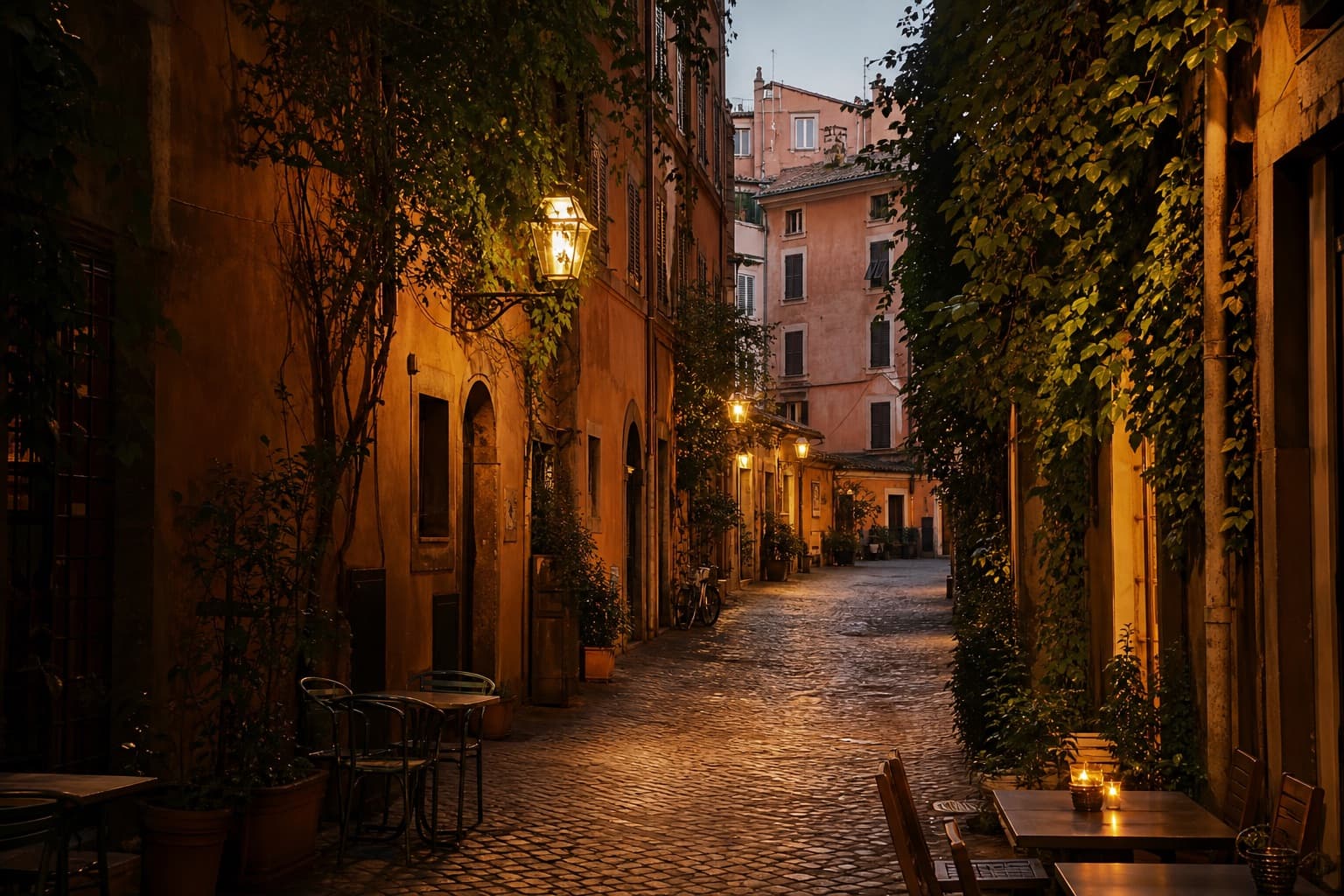
Trastevere means, quite simply, beyond the Tiber. For centuries it was the neighborhood of workers, craftsmen and immigrants, and it still keeps that character in its narrow streets of sampietrini, those black, square cobblestones, with the washing hung between balconies and the ivy eating up the facades. At its heart is the basilica of Santa Maria in Trastevere, one of the oldest churches in the city, with a facade covered in golden mosaics that at dusk seem to light up on their own.
To cross over here you can go by way of the Tiber Island, the small islet in the middle of the river joined to the bank by the Ponte Fabricio, the oldest Roman bridge still in use, standing since 62 BC. As night falls the neighborhood sheds its skin and fills with lanterns and people sitting on the steps of the squares, but its web of alleys has barely changed in centuries. Here, more than in any monument, you understand that Rome has never quite stopped being a village.
The thread that links the legends of Rome
What makes this Rome special is not each monument on its own, but the thread that links them: the she-wolf of the Palatine, the senators of Largo di Torre Argentina, the pyre of Giordano Bruno and the ghosts of Castel Sant'Angelo are all part of one and the same two-thousand-year story. Almost none of these tales is written on a sign, and that is why it is so hard to piece them together on your own from the stones.
That is where a free legends tour of Rome changes the experience: a local guide links the mythical founding, the Ides of March and the apparitions of the old town in a single walk, and leaves you with the keys to look at each square differently. At the end you leave the guide a contribution of between 15 and 20 euros per person, depending on how much the walk gave you, and it is a good way to make sense of so many centuries of myths before returning to the corners that intrigued you most.
Frequently asked questions
- Why is the Colosseum called that if it is not for its size?
- Its official name is the Flavian Amphitheater, after the dynasty that built it and inaugurated it in AD 80. The nickname Colosseum came later and comes from the Colossus of Nero, a bronze statue over thirty meters tall that rose right beside it. Over time, the name of that colossal figure ended up passing to the amphitheater in front of it.
- Is it true that Julius Caesar was killed in the Senate on the Capitol?
- No. That day the Senate was meeting in the Curia of Pompey, next to the Theater of Pompey, whose remains are today in Largo di Torre Argentina. The image of the Capitol and the steps comes mostly from later paintings and films, not from what happened on 15 March 44 BC.
- Where can you see the Capitoline she-wolf of Romulus and Remus?
- The bronze statue of the she-wolf suckling the twins is kept in the Capitoline Museums, on the Campidoglio hill that Michelangelo reordered centuries later. The legend sets the scene in the cave of the Lupercal, at the foot of the Palatine, where in 2007 a team of archaeologists located a cavity decorated with mosaics that many identified with that place.
- What ghost legend surrounds the Castel Sant'Angelo?
- The best known is that of Beatrice Cenci, the young woman beheaded in 1599 for taking part in the murder of her father, who is said to appear on the access bridge on each anniversary of her execution. The castle's very name is born of another apparition: that of the archangel Michael sheathing his sword over the building in the year 590, which Pope Gregory the Great read as the end of a plague.