In this article (7 sections)
The heart in the river: the Île de la Cité
Paris began here, on an island in the middle of the Seine. On the Île de la Cité rise Notre-Dame, with its facade rebuilt after the 2019 fire, and the Sainte-Chapelle, whose thirteenth-century stained glass lines the interior with colored light. A few meters away is the Conciergerie, the old prison where Marie Antoinette awaited her trial. Cross the Pont Neuf, the oldest bridge in the city despite its name (new bridge), and step over to the neighboring Île Saint-Louis for a Berthillon ice cream and streets with barely any traffic.
It is the point where almost all walks through the center begin, and also where a free walking tour usually starts: you set off from an easy place to find and from there the rest of the city orders itself on either side of the river.

Do it with a guide
The Original Free Tour of Paris
From medieval kings to revolutionaries and emperors, Paris is a city shaped by centuries of drama, beauty and bold ideas, that...
From the Louvre to the Arc de Triomphe: the grand axis
From the right bank opens the most famous straight line in Paris. It begins at the Louvre and its glass pyramid, continues through the Tuileries gardens and opens onto the Place de la Concorde, presided over by the Luxor obelisk. From there the Champs-Élysées set off, climbing on a gentle slope for almost two kilometers to the Arc de Triomphe, on the Place Charles de Gaulle.
It is a long stretch, but flat and comfortable. If you do not want to do it all, the Tuileries and the Concorde hold the best of the views, and you can always go up to the terrace of the Arc de Triomphe to see how the twelve avenues leave the square like the spokes of a wheel.
The bank of the Seine and the Eiffel Tower
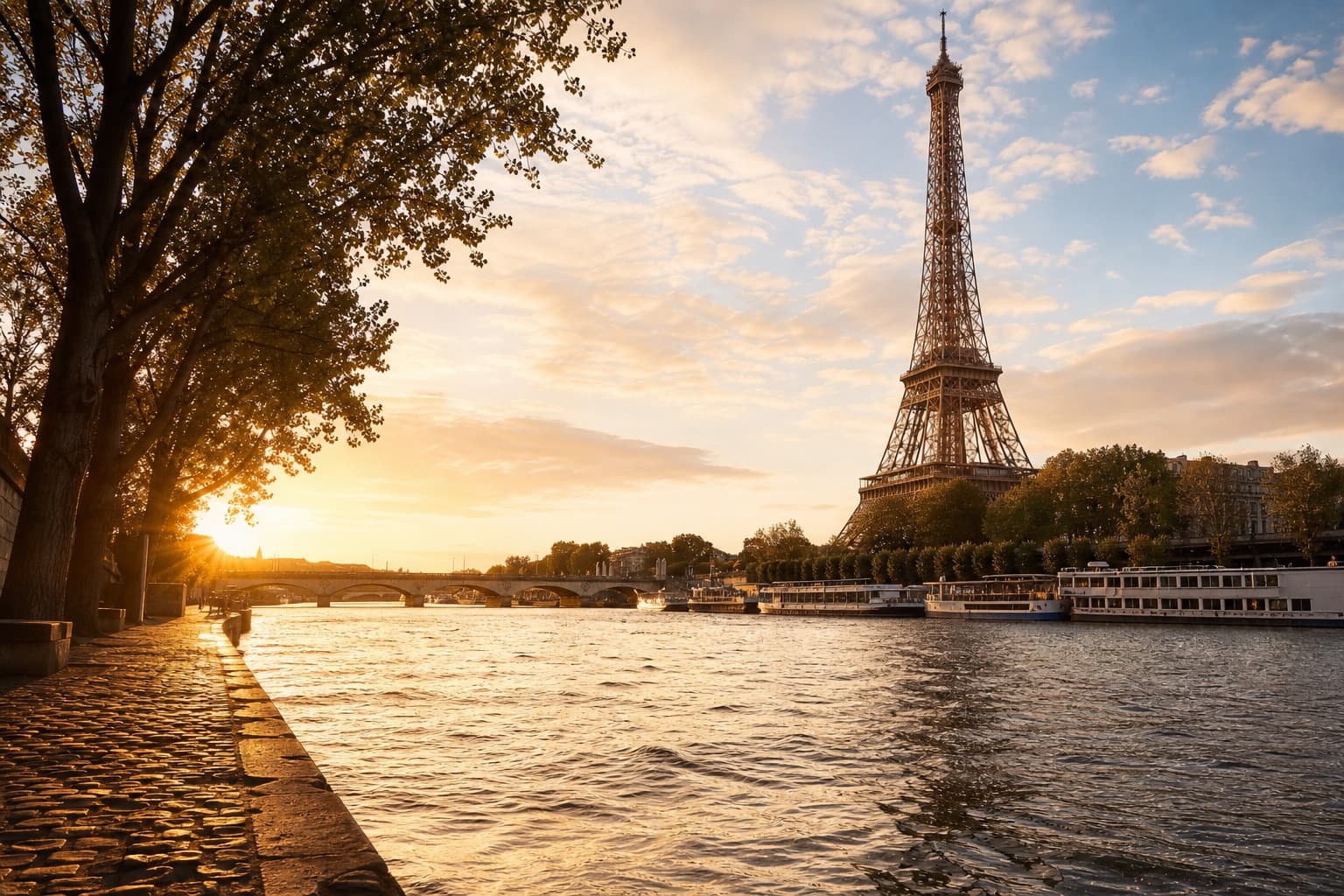
The Eiffel Tower is seen best from across the way. Cross to the Trocadéro, on the right bank, and from its esplanade you have the complete postcard, above all at dusk. Heading down toward the river you reach the Champ de Mars, the great lawn at the tower's feet and a good place to sit for a while.
On the left bank are Les Invalides, with Napoleon's tomb beneath its golden dome, and the Musée d'Orsay, an old train station turned into a museum of Impressionism. For a bite or a drink, the Rue Cler, pedestrian and with a market, takes you off the most touristy circuit without leaving the area.
Book free, leave a contribution at the end

Le Marais, the neighborhood you walk without a map
Le Marais is one of those places you enjoy by getting lost. Its center is the Place des Vosges, the oldest square in the city, with brick arcades and the house where Victor Hugo lived. Around it cross alleys with mansions, the so-called hôtels particuliers, small shops and the Rue des Rosiers, heart of the Jewish quarter, with its falafel spots.
On the edge of the neighborhood is the Centre Pompidou, with its pipes and escalators on the outside, recognizable from afar. Le Marais is also one of the liveliest neighborhoods at night, so it works just as well for a daytime stroll as for dinner and staying on.
Montmartre and the hill of the Sacré-Cœur
Montmartre is the high part of Paris and your legs will notice it. The basilica of the Sacré-Cœur crowns the hill and from its steps you have one of the best views of the city, with no admission to pay. Behind it comes the Place du Tertre, full of portrait artists, and along the surrounding lanes appear the only vineyard in Paris, the Café des Deux Moulins on the Rue Lepic and, at the foot of the hill, the Moulin Rouge in Pigalle.
It is a neighborhood of steps, slopes and cobblestones, so here more than anywhere else comfortable footwear is appreciated. Going with a guide who knows the shortcuts saves detours and places this hill of painters and cabarets for you at a glance.
The left bank: the Latin Quarter and Saint-Germain
South of the Seine is university Paris. The Latin Quarter revolves around the Sorbonne and the Panthéon, where Voltaire, Rousseau and Marie Curie rest. Go down the Rue Mouffetard, one of the oldest market streets, and end at the Luxembourg Gardens, with their green chairs beside the pond, ideal for a break.
Toward the west, Saint-Germain-des-Prés keeps the literary cafés, like Les Deux Magots and the Café de Flore, and the Shakespeare and Company bookshop, opposite Notre-Dame, closes the circle and brings you back to the river where you started.
Frequently asked questions
- How many days do you need to see Paris on foot?
- With three full days you cover the center without stress: one for the Île de la Cité and the grand axis from the Louvre to the Arc de Triomphe, another for the Eiffel Tower and the left bank, and a third for Le Marais and Montmartre. If you only have a weekend, prioritize the historic center and the tower area, which is where the distances are shortest.
- Can you walk from Notre-Dame to the Eiffel Tower?
- Yes, and it is one of the best walks in the city. It is about 3.5 kilometers along the bank of the Seine, a little under an hour, passing the Musée d'Orsay and Les Invalides. If you have time, do it at the end of the day to reach the tower in the light of dusk.
- Is a free walking tour of the center worth it?
- For the first day it helps a lot to get your bearings: a local guide lays out the history and the distances, and then you head back on your own to whatever interested you most. They are booked with no payment up front and at the end you leave the guide a contribution of between 15 and 20 euros per person, depending on how the walk went for you.
- Which area is best for an evening stroll?
- The bank of the Seine and its bridges, with the monuments lit up, and the Trocadéro to see the Eiffel Tower lit, which every hour after nightfall puts on a five-minute light show. Le Marais is the best option if you are after an atmosphere of bars and restaurants until late.